
Yamaha YHT-4970U
4.5Editor score
Complete 5.1 speaker package
Dolby Atmos receiver included
Automatic room correction
4K120 and 8K support
Bluetooth Multipoint streaming
A Dolby Atmos home theater system can transform a television, streaming service, or game console into a convincing cinematic experience by adding directional sound, overhead effects, and deeper bass. The right package depends on room size, speaker placement, connected equipment, and how much emphasis you place on convenience versus traditional component-based control.
We compared all-in-one receivers, compact surround bundles, soundbar-based systems, and wireless speaker packages. Our evaluation focused on channel configuration, height-speaker capability, subwoofer performance, room calibration, connectivity, dialogue handling, video support, and the practical effort required to install each system.
The list covers ten distinct approaches, from a straightforward 5.1 home theater package to elaborate 11.4.6 cinema systems. Each review identifies the strongest reasons to consider that model, along with practical trade-offs. Product listings and configurations can change, and prices should always be checked before buying.
4.5Editor score

4.6Editor score
4.4Editor score
As an Amazon Associate we earn from qualifying purchases.
This side-by-side comparison highlights the major architectural differences among the ten systems, ranging from a receiver-based 5.1 package to fully wireless and component-driven cinema configurations.


The Samsung Q990F is a high-feature soundbar-based home theater system that combines 11 front and surround channels, one subwoofer channel, and four up-firing channels. Its 4.3 rating reflects a system that covers a broad range of functions, from wireless Dolby Atmos and surround playback to smart-device integration and room optimization. Its most appealing characteristic is the amount of spatial coverage it attempts to create without requiring a separate AV receiver and loose speaker wire.
We may earn a commission when you buy through this link, at no additional cost to you.
The included subwoofer and rear speakers make the setup more cinematic than a conventional compact soundbar. Four up-firing channels add the overhead dimension that distinguishes Atmos from ordinary surround sound, while the room sensors analyze the listening area and adjust the sound, including bass behavior. Q-Symphony allows compatible Samsung TVs and additional compatible Samsung speakers to participate in the soundscape, potentially improving the sense of front-to-back continuity and tonal nuance.
The system also adapts to modern viewing habits. Game Mode Pro is intended to optimize the presentation for compatible games, while Adaptive Sound can emphasize dialogue when background noise makes speech difficult to follow. Alexa, Googlecast, and AirPlay 2 support make the Q990F useful for more than movies. These capabilities do add complexity, however, and the speakers occupy a substantial amount of space. Buyers who do not use Samsung televisions or related devices may not receive the full benefit of the ecosystem features.
This is a strong recommendation for a large living room or dedicated media area where the owner wants many channels, wireless rear speakers, and automatic tuning without assembling a traditional component system. It is less suitable for a compact room or for someone who values receiver-based control over soundbar features. Within the soundbar category, the Q990F stands out for the breadth of its channel architecture and its unusually rich feature set.
The four up-firing channels and wireless rear speakers create a more complete Atmos presentation than a small all-in-one soundbar. Placement still matters, so the system needs enough open space above and around the listening position for its height cues to be convincing.
Embedded room sensors can tailor output to the surrounding space, while automatic voice emphasis helps during noisy films or everyday broadcasts. Together, these functions reduce the need for frequent manual adjustments.
We may earn a commission when you buy through this link, at no additional cost to you.
The Sony BRAVIA Theater System 6 is a 5.1-channel package built around a soundbar, two rear speakers, and an included subwoofer. It carries a 4.4 rating and offers a more traditional front, side, and rear arrangement than many soundbar competitors. Dolby Atmos and DTS:X support make it a practical option for viewers who want an enveloping presentation without the complexity of a full receiver-based installation.
We may earn a commission when you buy through this link, at no additional cost to you.
Three front-firing speakers work with the two rear units and subwoofer to create a conventional surround stage. A dedicated center channel is especially useful for dialogue because it keeps voices anchored at the center of the screen. Multi Stereo can repeat playback across the available speakers to produce a fuller, room-filling effect, while the system up-mixes music to restore acoustic detail as part of its stated processing.
Its strongest appeal is the balance between useful cinema features and manageable setup. Pairing it with a compatible BRAVIA TV allows control from the television menu and adds access to Voice Zoom 3 for dialogue clarity. The BRAVIA Connect app provides another route to volume, sound profiles, and advanced configuration. Bluetooth also covers music playback from a phone. The trade-off is that its five-channel foundation is less elaborate than the 7.1.4, 9.2, 11.1.4, and 11.4.6 systems elsewhere in this guide.
This system is best for a medium-sized room, a family entertainment area, or a viewer who wants rear speakers and a subwoofer without wrestling with speaker wire and an AV receiver. It may not deliver the same overhead sensation as a system with dedicated height channels. Even so, for a compact home theater package with strong format support, dialogue handling, and television integration, the BRAVIA Theater System 6 is a convincing all-around choice.
Front, center, rear, and subwoofer channels create a familiar home theater presentation. This arrangement can be easier to understand and adjust than a much larger height-channel system, particularly in a multipurpose living room.
The center speaker gives voices a dedicated home, and BRAVIA pairing adds menu control and Voice Zoom 3. These features are particularly useful for news, scripted television, and films with quiet conversations.
We may earn a commission when you buy through this link, at no additional cost to you.
The Yamaha YHT-4970U is a traditional all-in-one home theater system built around the Yamaha RX300A AV receiver. The package includes two front speakers, a center speaker, two surround speakers, a powered subwoofer, speaker wire, and a subwoofer cable. Its 4.5 rating and comprehensive box contents make it a practical option for buyers who want more control and conventional speaker placement without assembling every component separately.
We may earn a commission when you buy through this link, at no additional cost to you.
Dolby Atmos and DTS Virtual:X processing add dimensional sound to a 5.1 speaker package. The receiver supports 4K at 120Hz and 8K at 60Hz, along with Dolby Vision, HDR10+, ALLM, VRR, HDMI eARC, and HDMI switching. These capabilities make the system suitably future-facing for a broad range of modern television, console, and source-device configurations.
A major advantage is the included setup microphone, which lets the receiver measure room acoustics and speaker characteristics before optimizing performance. The result is likely to be more consistent than relying on uncalibrated factory settings, especially in a room with unusual furniture or wall surfaces. Quick Guide setup, on-screen menus, sound modes, and four custom presets also make the receiver approachable. The trade-off is physical installation: the included speakers use wired connections, and the package has no dedicated height speakers for true overhead positioning.
This is the best budget-oriented choice in the guide for a buyer who values an AV receiver, automatic room correction, extensive video support, and a complete speaker set in one package. It suits a dedicated room or a living room where running two rear-speaker cables is manageable. Those wanting a soundbar-style installation or genuine height channels should spend up, but the YHT-4970U delivers an unusually complete foundation for a conventional home theater.
Unlike a self-contained soundbar, the RX300A gives the system familiar source selection, video switching, sound modes, and custom scene controls. It is a less conspicuous way to build a traditional theater around a television.
The supplied microphone measures the listening environment and speaker behavior so the receiver can optimize output. This is valuable in rooms where furniture, curtains, and wall shapes could otherwise create uneven bass or muddy transitions.
We may earn a commission when you buy through this link, at no additional cost to you.
The ULTIMEA Skywave X70 is a 7.1.4-chapter wireless surround system with a soundbar, a 10-inch wireless subwoofer, and wireless rear and height components. Its 4.7 rating is the highest among the listed products, making it notable for the combination of cable-free surround placement, extensive processing, and app-based control. The system is aimed at viewers who want a broad soundstage but do not want to run traditional speaker cables around the room.
We may earn a commission when you buy through this link, at no additional cost to you.
Dual 5GHz transmission is the foundation of the wireless approach, with the stated goal of stable connectivity and reduced interference. A GaN amplifier, triple-core DSP, dual-core MCU, and support for high-resolution processing are central to the product's technical positioning. The subwoofer uses a large 10-inch driver with a stated peak output of 980 watts, while the multi-channel engine is said to support as many as 17 channels for surround imaging and height realism.
The ULTIMEA app adds OTA updates, a 10-band equalizer, and 121 sound presets, while 4K HDR passthrough and CEC control simplify integration with a television. The included subwoofer and rear speakers are wireless, but soundbar-based height effects still depend on placement and room reflections. That is an important distinction: a 7.1.4 label does not guarantee the same overhead precision as physically elevated speakers positioned directly above the listener.
The X70 is an attractive option for a modern apartment, loft, or living room where cable management is a priority. Its 4.7 rating, large wireless subwoofer, and extensive customization make it particularly compelling. Buyers should still examine the room, confirm that the included wireless components can be positioned effectively, and avoid assuming every listed processing specification translates into a visible benefit for every source.
The wireless architecture is the Skywave X70's defining advantage. It allows rear and upper effects to be positioned without traditional wiring, making the system more adaptable to rental spaces and finished rooms.
A 10-inch driver gives the subwoofer more physical surface area than many compact soundbar subs. The result should be easier to hear and feel on action sequences, provided room placement and calibration are handled carefully.
We may earn a commission when you buy through this link, at no additional cost to you.
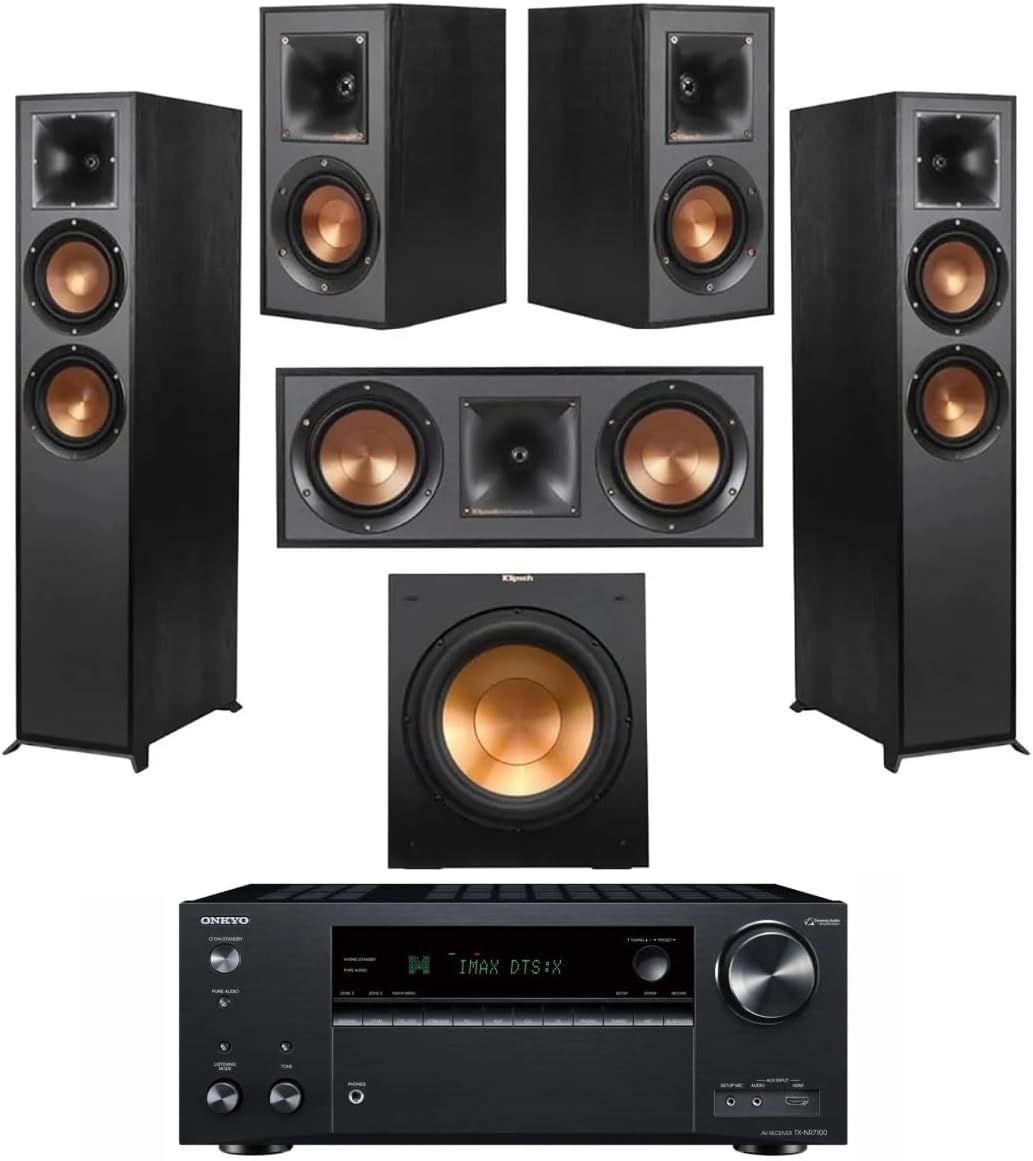
The Klipsch Reference Dolby Atmos Home Theater with Onkyo TX-NR7100 is the most traditional premium component system in the guide. It combines an Onkyo 9.2-channel receiver, Klipsch Reference speakers, and a Klipsch R-12SW 12-inch powered subwoofer. Its 4.4 rating reflects a package capable of serious surround and height-channel performance, provided the buyer has enough room to install the speakers properly.
We may earn a commission when you buy through this link, at no additional cost to you.
The two R-625FA floorstanding speakers include built-in up-firing Dolby Atmos elevation channels. That physical design is meaningful because the speakers create height effects from their own upward-firing drivers rather than relying exclusively on a compact soundbar's reflected output. A dedicated R-52C center channel handles focused dialogue, while R-41M bookshelf speakers provide the rear soundstage. The mix creates a genuine home-theater arrangement that can be adjusted through the receiver.
The TX-NR7100 supplies 9.2-channel processing, 8K and 4K video support, Dolby Atmos, HEOS streaming, voice-control support, and automatic room calibration. Its stated 220-watts-per-channel output under the specified conditions gives it the headroom expected of a dedicated receiver. The R-12SW uses a 12-inch spun-copper IMG driver and an all-digital amplifier for low-frequency impact, while the scratch-resistant wood-grain cabinets provide a more furniture-friendly appearance than many black component systems.
This bundle is the right choice for a serious dedicated theater or a living room designed around speakers rather than television aesthetics. It offers a clear upgrade path through receiver channels and a more credible height implementation than many compact systems. Its disadvantages are physical: floorstanders need room to breathe, connections require planning, and the whole package can overwhelm a small space. For those constraints, a soundbar-based model is easier.
The R-625FA floorstanders use dedicated up-firing elevation drivers to place Atmos overhead effects within the front soundstage. This is a strong alternative to bounced height sound from a television soundbar.
The 12-inch R-12SW provides substantially more cone area than compact soundbar subwoofers. It is better suited to larger rooms and demanding action films where the goal includes physical impact.
We may earn a commission when you buy through this link, at no additional cost to you.
The Samsung Q990H is an 11.1.4-channel Q-Series system with a soundbar, wireless subwoofer, and wireless rear speakers. Its 3.8 rating is the lowest in this comparison, so buyers should examine current customer feedback and verify the exact package contents carefully. Nevertheless, the underlying feature set is extensive for a soundbar-based system, including four up-firing channels, Dolby Atmos, Q-Symphony, and automatic room calibration.
We may earn a commission when you buy through this link, at no additional cost to you.
The Q990H's headline capability is broad spatial coverage without the number of physical speakers associated with a component theater. Eleven front and surround channels, a subwoofer channel, and four upward-firing drivers can provide a broad front-to-rear and overhead presentation. The soundbar can deliver wireless Dolby Atmos with or without an HDMI connection, depending on the source and setup, offering flexibility for users who do not want to rely on a single wired pathway.
Q-Symphony is its most distinctive ecosystem feature. With a compatible Samsung television and up to five compatible Samsung audio devices, the system can use them together for a more robust and detailed sound. SpaceFit analyzes the room and optimizes sound and bass automatically, while AI Dynamic Bass Control is designed to reduce distortion. Alexa, Googlecast, and AirPlay 2 are also supported, giving the package broad smart-home utility.
This is a good option for a Samsung household that already owns a compatible television and wants a polished, high-channel soundbar system. The main caution is that some advantages are less meaningful outside the Samsung ecosystem. Its 3.8 rating also warrants more careful auditioning or recent-review reading than the higher-rated products. Within that context, the Q990H remains a feature-rich and visually streamlined way to add cinematic sound.
Compatible Samsung TVs and speakers can participate in the same soundscape, which may create a more continuous front stage and distribute output more effectively. The benefit is most relevant for buyers already invested in that platform.
SpaceFit sound and AI Dynamic Bass Control target two common soundbar weaknesses: mismatched room acoustics and overly forceful low frequencies. Automatic adjustment is convenient, though it cannot fully replace sensible speaker placement.
We may earn a commission when you buy through this link, at no additional cost to you.
The Nakamichi Dragon is the most explicitly cinema-oriented soundbar system in the guide, combining an 11.4.6-channel architecture with dual opposing eight-inch subwoofers and separate surround speakers. Its 4.6 rating reflects the product's scale, feature depth, and format support. Unlike a compact one-piece soundbar, the Dragon is designed to move substantial quantities of air and fill a room with a front soundstage, elevated effects, and physically forceful low frequencies.
We may earn a commission when you buy through this link, at no additional cost to you.
The Pro Cinema surround engine supports Dolby Atmos configurations up to 24.1.10 and DTS:X Pro up to 30.2, with the product described as operating at AV receiver processing depth. HiFi Air Motion tweeters support the front stage, while bipolar height surrounds project from both sides and above. A PerfectHeight mechanism is included to help lock overhead effects into a more useful listening position. The system can also scale its bass architecture to support as many as four subwoofer enclosures.
Connectivity is well suited to a modern theater. HDMI eARC and three HDMI 2.1 inputs support 4K at 120Hz with Dolby Vision and HDR10+, and the system includes Bluetooth, optical, and 3.5-millimeter auxiliary connections. An on-screen display, backlit remote, and app provide control. The main trade-off is physical scale: the main unit is 58.1 inches wide, the subwoofer cabinets are large, and the package ships in three boxes. A large screen, large room, and careful placement are advisable.
The Dragon earns the Editor's Choice designation because it offers one of the most complete ways to build an enveloping theater from a soundbar-based architecture. It is ideal for enthusiasts who value immense scale, extensive processing, and the flexibility of adding bass enclosures. Buyers with modest rooms, smaller televisions, or a preference for understated equipment may find more appropriate results from the Yamaha, Sony, or Klipsch compact packages.
The 58.1-inch chassis is unusually wide for a soundbar, allowing multiple front drivers and tweeters to create a broad, forceful front stage. That size demands a large viewing area and furniture wide enough to support it.
Two opposing eight-inch subwoofers can cancel some unwanted cabinet motion while delivering strong output. Their footprint is substantial, but the design targets the room-filling low-frequency impact associated with commercial cinema.
Three HDMI 2.1 inputs provide convenient switching for consoles and media devices, while 4K 120Hz, Dolby Vision, and HDR10+ support cover current high-performance display standards. An eARC connection links the system to the television.
We may earn a commission when you buy through this link, at no additional cost to you.
The Klipsch Reference Cinema Dolby Atmos 5.1.4 System is a compact home theater package distinguished by four satellite speakers with built-in height effects. Its 4.5 rating reflects a favorable combination of immersive output, specialized Klipsch drivers, and a relatively simple all-in-one approach. The speakers are designed to project height information from both the front and rear, which is more direct than relying only on a soundbar's upward-firing channels.
We may earn a commission when you buy through this link, at no additional cost to you.
Tractrix 90-by-90-degree horn technology and aluminum tweeters are used to improve high-frequency response and extension. The system includes a subwoofer with a built-in all-digital amplifier, providing efficient amplification and control for low-frequency effects. The result is a conventional center-channel presentation with a stronger overhead dimension than most basic 5.1 packages, provided the four height-equipped satellites are positioned correctly.
The package is attractive for a smaller media room because it avoids the scale of a large floorstanding system or a multi-box cinema package. Its main limitation is the relatively modest 5.1 base layer. There is no nine-channel receiver in the box, no large 12-inch subwoofer, and no indication of advanced object-based processing beyond the included height effects. Buyers who want extensive codec support, gaming features, and deep menu-based control should choose a receiver-based option.
This is a good match for viewers who prioritize credible overhead cues, compact cabinets, and straightforward theater setup. It can be an effective first home theater system and is easier to accommodate than a full component bundle. For a larger room, more receiver control, or a greater emphasis on deep bass, the Yamaha YHT-4970U or Klipsch and Onkyo bundle offers a stronger foundation.
Dedicated height behavior in both front and rear satellites gives the system a more intentional overhead presentation. Proper elevation and distance from the screen remain essential for the effect to merge with the front and rear soundstage.
The subwoofer's all-digital amplifier is designed for high efficiency and accurate output. It provides the necessary low-frequency foundation without requiring a separate receiver power channel.
We may earn a commission when you buy through this link, at no additional cost to you.
The Bose Home Theater System combines the Bose Smart Ultra Dolby Atmos Soundbar, Bass Module 700, and two wireless surround speakers. Its 4.2 rating places it in the middle of the group and reflects a straightforward branded package focused on ambience, dialogue, and convenient installation. The bundle includes a remote, ADAPTiQ headset, optical and HDMI cables, power cord, quick-start guide, and a one-year limited warranty.
We may earn a commission when you buy through this link, at no additional cost to you.
The soundbar supports Dolby Atmos, and the two satellite speakers extend playback beyond the television cabinet. Bass Module 700 handles low-frequency output separately, allowing the main soundbar to reproduce higher-frequency material without also driving a large woofer. Voice4Video is intended to improve the clarity of spoken dialogue, while Alexa and Google Assistant support add voice-control options for compatible functions and connected services.
The principal advantage is simplicity backed by a familiar home audio brand. A buyer receives the main bar, a subwoofer, and two surrounds without assembling a receiver or comparing separate speaker models. Wireless rear placement also reduces cable clutter. The drawback is that the supplied product information provides fewer measurable details about channel count, speaker drivers, decoding configurations, and calibration than the most technically transparent competitors.
This package is a reasonable fit for a consumer who values Bose styling, straightforward setup, and an established soundbar ecosystem. It is also potentially appealing for Alexa or Google Assistant users. Those seeking specific channel counts, object-based processing depth, component-level routing, or gaming-specific receiver features should compare one of the more extensively specified systems before deciding.
The Smart Ultra soundbar's dialogue tools and Voice4Video function target intelligibility, while separate surround speakers broaden the presentation. This makes the bundle well suited to television, streaming, and casual movie nights.
Matching soundbar, module, and satellites reduce the need to evaluate unrelated components. The result is a coordinated system with a single visual language, although buyers should verify compatibility and included accessories before purchase.
We may earn a commission when you buy through this link, at no additional cost to you.
The Sonos Arc Ultra is a single-piece Dolby Atmos soundbar with a 4.6 rating, strong smart-home integration, and an expandable design. Its 9.1.4 spatial architecture and Sound Motion technology are intended to place sound around and above the listener. Unlike the bundled systems in this guide, the Arc Ultra is sold here as the central soundbar, with deeper surround and bass performance available through additional Sonos products.
We may earn a commission when you buy through this link, at no additional cost to you.
The architecture places eleven channels of horizontal and height information around a four-channel subwoofer array. AI-powered Speech Enhancement detects human voices and can clarify dialogue, while Trueplay adjusts the presentation to the room. The bar connects to a television through a single HDMI eARC cable, and the Sonos app provides step-by-step setup, making the initial process unusually approachable.
Its wider strengths are connectivity and control. The system supports Wi-Fi, Bluetooth, Apple AirPlay 2, and Spotify Connect. It can be operated through a television remote, the Sonos app, touch controls, Sonos Voice Control, or Amazon Alexa. It also integrates with Sonos speakers in other rooms. The tradeoff is that the standalone configuration lacks the deep bass and rear output of a complete package, and many of the most impressive effects depend on adding a Sonos Sub and compatible Era 300 rear speakers.
The Arc Ultra is best for a minimalist room, a Sonos household, or a buyer who wants a polished soundbar before deciding whether to expand. Its combination of design, streaming convenience, dialogue tools, and a high 4.6 rating makes it one of the strongest all-around choices. If a complete system is the goal, the Samsung, Sony, Yamaha, Nakamichi, and Klipsch bundles in this guide include more of the required hardware immediately.
Sound Motion technology is designed to distribute audio across the room rather than rely on a narrow line of drivers. The low-profile enclosure also reduces visual competition with a large television.
The Arc Ultra can be paired with a Sonos Sub and Era 300 rear speakers for a more complete Atmos stage. That flexibility lets buyers begin with one product and expand as room needs or listening habits change.
Wi-Fi, Bluetooth, AirPlay 2, Spotify Connect, voice assistants, app control, and television remote control cover most modern listening routines. Setup remains centered on a single eARC connection and guided app steps.
We may earn a commission when you buy through this link, at no additional cost to you.
The right Dolby Atmos home theater system depends on room dimensions, installation tolerance, source equipment, and preferred control method. Channel count is important, but speaker placement, bass capability, video support, and room calibration often have a greater effect on the final experience.
A soundbar-based system concentrates the main speaker array in one enclosure and uses wireless satellites for rear or height effects. It is simpler to install and often better suited to a living room with limited wiring. A component system uses an AV receiver and separate speakers, allowing more flexible placement, individual speaker selection, and conventional source routing. The Yamaha YHT-4970U provides the latter approach in one box, while the Samsung and Sony systems use a soundbar as the central hub.
Choose a soundbar when appearance, quick installation, and minimal cable clutter matter most. Choose components when you want a stable home-theater platform, multiple source devices, extensive sound-field settings, and the freedom to add or replace speakers. The most expensive soundbar architecture is not automatically better than a carefully installed five-speaker package.
The first number in a 5.1, 7.1.4, 9.2, or 11.4.6 label describes the main channel count, while the final number indicates height channels. The decimal separates the subwoofer channel from the main channels. A 5.1.4 system has five main channels, one subwoofer channel, and four height effects, while 11.4.6 includes eleven main channels, four subwoofers, and six height channels. These numbers describe processing architecture, not necessarily the number of visible speaker cabinets.
Do not choose solely by the largest label. A well-positioned 5.1.4 system can sound more convincing than a poorly placed 11.1.4 system. Match the architecture to the room and verify how each height channel is generated, whether through dedicated drivers, upward-firing speakers, processing, or a combination.
Atmos height effects need somewhere to go. Physical up-firing speakers, such as those in the Klipsch Reference Cinema and floorstanding speakers in the Klipsch and Onkyo bundle, project upward from their cabinets. Soundbar-based systems often use upward-firing drivers or simulate height effects through processing and reflections. Wireless satellites make rear placement easier, but they still need to sit behind the main listening position rather than immediately beside the television.
Measure the room before ordering a large system. Check the distance between speakers, the width of the display cabinet, and the available side and rear space. For a dedicated room, physical elevation and separation offer more control; for a multipurpose space, compact wireless rears may be the more realistic choice.
Subwoofer specifications tell only part of the story. Driver size, cabinet volume, amplifier power, control features, and room calibration all influence the final result. The Nakamichi Dragon uses two opposing eight-inch drivers, the ULTIMEA Skywave X70 includes a ten-inch wireless subwoofer, and the Klipsch and Onkyo package uses a 12-inch powered unit. These larger drivers can create more output and physical impact, but they also require more space and careful placement.
A larger subwoofer is not automatically suitable for a small room, where excessive low-frequency output may cause fatigue or muddy the midrange. Look for calibration, level controls, and phase or bass-management functions. The Yamaha receiver, Samsung SpaceFit systems, and Onkyo calibration tools can help align the subwoofer with the rest of the soundstage.
Automatic room correction can meaningfully improve a home theater by measuring speaker distance, level, and room response. Yamaha includes a setup microphone with the YHT-4970U, the Onkyo TX-NR7100 supports automatic room calibration, Samsung uses SpaceFit sensors, and Sonos offers Trueplay. Each approach has limitations, but all provide better starting conditions than uncalibrated factory presets.
Calibration works best in a settled room with soft furnishings, closed curtains, and speakers in their final positions. Avoid placing a subwoofer in a tight corner unless the manufacturer specifically recommends it. After automatic correction, listen at normal levels and make small manual adjustments for personal preference.
An Atmos system is likely to be connected to a television, game console, and media player, so video support matters. The Yamaha RX300A and Onkyo TX-NR7100 support advanced high-resolution and gaming features, including 4K at 120Hz, VRR, and ALLM where the full system supports them. The Nakamichi Dragon includes three HDMI 2.1 inputs and supports 4K 120Hz with Dolby Vision and HDR10+.
For other systems, confirm the available inputs and supported display formats, especially when a soundbar relies on eARC for television audio. Gaming features such as variable refresh rate reduce tearing, while low-latency auto switching can make console operation more seamless. A capable receiver is generally the most flexible choice for multiple high-bandwidth devices.
A home theater system should also work well when nobody is watching a movie. Samsung models support platforms such as Googlecast and AirPlay 2, the Sony system includes Bluetooth, the Yamaha receiver supports Bluetooth Multipoint, and Sonos offers Wi-Fi, Bluetooth, AirPlay 2, and Spotify Connect. Voice assistants can add convenience, though they are not equally useful across every content source.
Decide whether smart features or component control matter more. Ecosystem integration can be seamless when related devices are already owned, but proprietary features may have little value to another brand's equipment. Confirm the required app, network requirements, remote-control behavior, and whether the soundbar can be controlled directly from the television.
A large cinematic system can overwhelm a compact room, while a small system may struggle to fill a spacious dedicated theater. The Nakamichi Dragon's 58.1-inch main unit and multiple large subwoofer cabinets require substantial furniture and placement room. The Sony, Klipsch Reference Cinema, and Yamaha options are more compact, while the Sonos Arc Ultra offers a gradual expansion path.
For a small multipurpose room, prioritize a clear center channel, controllable bass, and a compact or wireless rear solution. For a large room, consider greater speaker separation, powerful bass, and a receiver that can handle multiple surrounds and height channels. The most cinematic label is useful only when the room can support it.
Begin by positioning the main soundbar or front speakers below or beside the television, then place the subwoofer near a wall without blocking it. Wireless rear speakers should be positioned behind or to the sides of the main seating area. For a receiver-based system, connect each speaker to its matching output and follow the supplied guide for wiring and amplifier channels.
After connecting the speakers, connect the receiver or soundbar to the television. Select the correct HDMI input, enable the required audio format, and use the included calibration microphone or built-in room-tuning function. Run calibration from the intended listening position, with curtains closed and normal room furnishings in place, then make small level adjustments based on dialogue clarity and bass preference.
For care, keep vents unobstructed, wipe surfaces with a dry soft cloth, and avoid pushing objects into drivers or bass reflex ports. Do not place a subwoofer against a heat source or expose electronics to moisture. Review firmware and app updates when offered, periodically check cables and wireless connections, and update the system whenever the television, console, or streaming service changes.
No. Many soundbar-based systems include their own amplifiers, decoding, and wireless rear speakers, while all-in-one packages such as the Yamaha YHT-4970U include a receiver with the speakers. A separate receiver is useful when you want traditional source switching, extensive routing, independent speaker control, and an easy path to expand a conventional component system.
Both include five main channels and one subwoofer channel, but 5.1.4 adds four height channels. Those height effects can come from dedicated up-firing or elevated speakers and help create the overhead dimension associated with Atmos. The additional channels do not guarantee a better result if the speakers are poorly placed.
Modern wireless systems can provide excellent results and greatly simplify installation, particularly in rooms where running cables is undesirable. The strongest performance still depends on stable wireless transmission, proper placement, and adequate room calibration. Wired component systems remain attractive for buyers who value maximum control and no concern about wireless interference.
No. A larger driver can produce greater output and deeper bass, but room size, cabinet design, amplifier quality, calibration, and placement determine the result. A large subwoofer in a small room may be excessive, while a well-tuned smaller subwoofer can integrate more naturally with the rest of the system.
For most television-based systems, HDMI eARC is the simplest way to send Atmos audio from a television or connected source to a soundbar or receiver. Some systems also support wireless Atmos or other transmission methods, but compatibility depends on the television, source, and soundbar. Verify the supported input format before installation.
Leave enough room for each speaker's drivers and ports to operate without obstruction, and follow the manufacturer's placement guidance. Rear speakers generally work best behind or to the sides of the listening position, while a subwoofer can often sit near a wall. Many systems include automatic calibration, but it cannot correct severely cramped placement.
Many systems can expand, but compatibility depends on the model. The Sonos Arc Ultra can be paired with a Sonos Sub and Era 300 rear speakers, while the Yamaha and Onkyo receiver systems can use their channel architecture to add compatible speakers. Confirm supported outputs, impedance requirements, and manufacturer recommendations before purchasing additions.
Yes. Calibration should be completed after the speakers and subwoofer are in their final positions and the room is in its normal listening condition. It provides a better balance among channels, dialogue, and bass. Periodic recalibration can help after furniture changes or if you notice inconsistent volume between sources.
The Yamaha YHT-4970U is the most balanced budget-oriented package, combining a receiver, five speakers, a powered subwoofer, room calibration, and modern video support. The Nakamichi Dragon takes the Editor's Choice position for its enormous 11.4.6 architecture, dual subwoofers, and receiver-depth processing, while the Klipsch and Onkyo bundle stands as the premium traditional component option with real height speakers and a 12-inch subwoofer.
Prioritize room fit, speaker placement, and the way you watch rather than the largest channel number. A compact 5.1.4 system can be ideal for a living room, while a large dedicated theater may benefit from separated speakers, substantial bass, and advanced receiver control. Also consider whether a complete bundle is more convenient than a soundbar that can be expanded gradually.
Before purchasing, confirm the exact included components, room requirements, source compatibility, and current availability. Prices and promotions change regularly, so check the latest listing and warranty information at the time of purchase. With those checks completed, the right system can add genuinely immersive atmosphere while remaining practical for your space and daily use.