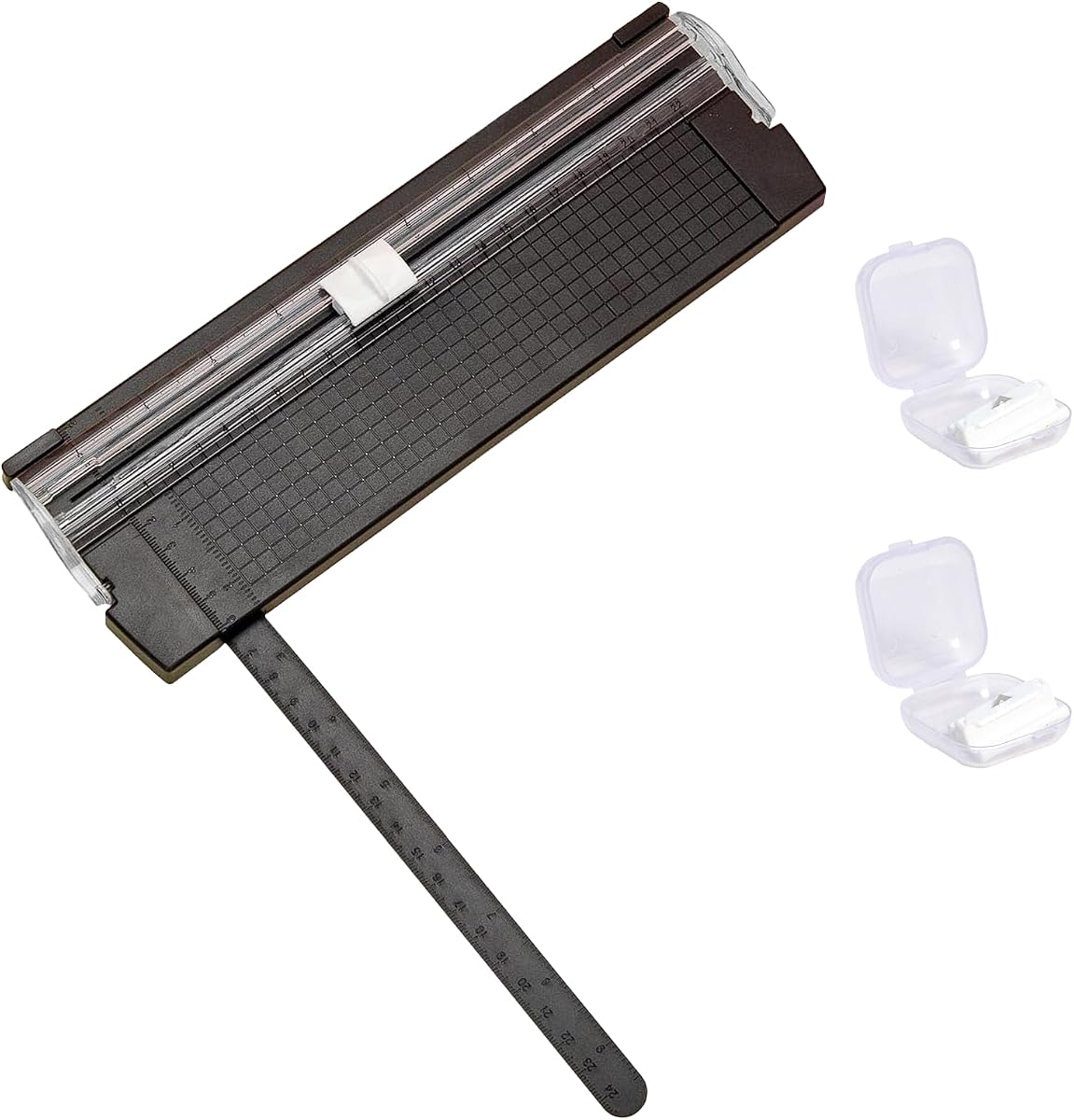
Paper Cutter Slider A5
4.2Editor score
Compact 10.6-inch base
Integrated measuring grid
Blade lock and guard
An A5 paper cutter provides a controlled way to trim paper, photos, cardstock, labels, and craft materials to a consistent size. A worthwhile model combines a sharp blade, reliable measurement system, stable base, convenient safety features, and enough capacity for the materials you routinely cut.
This guide compares ten compact and multipurpose cutters based on the supplied specifications, including cutting width, sheet capacity, blade construction, scoring or perforating functions, measurement aids, portability, and safety design. The list covers simple A5 trimmers as well as three-in-one tools for more demanding paper crafts.
Each review identifies the strongest feature of its product and explains the practical trade-offs. The top selections represent the strongest options for different priorities, including value, versatile paper crafting, and premium precision. Product details, ratings, and availability can change, so confirm the current listing before purchasing.
4.2Editor score

5.0Editor score

4.7Editor score
As an Amazon Associate we earn from qualifying purchases.
The comparison below places all ten cutters side by side, emphasizing the differences in cutting capacity, measurement systems, blade functions, portability, and intended paper-crafting applications.


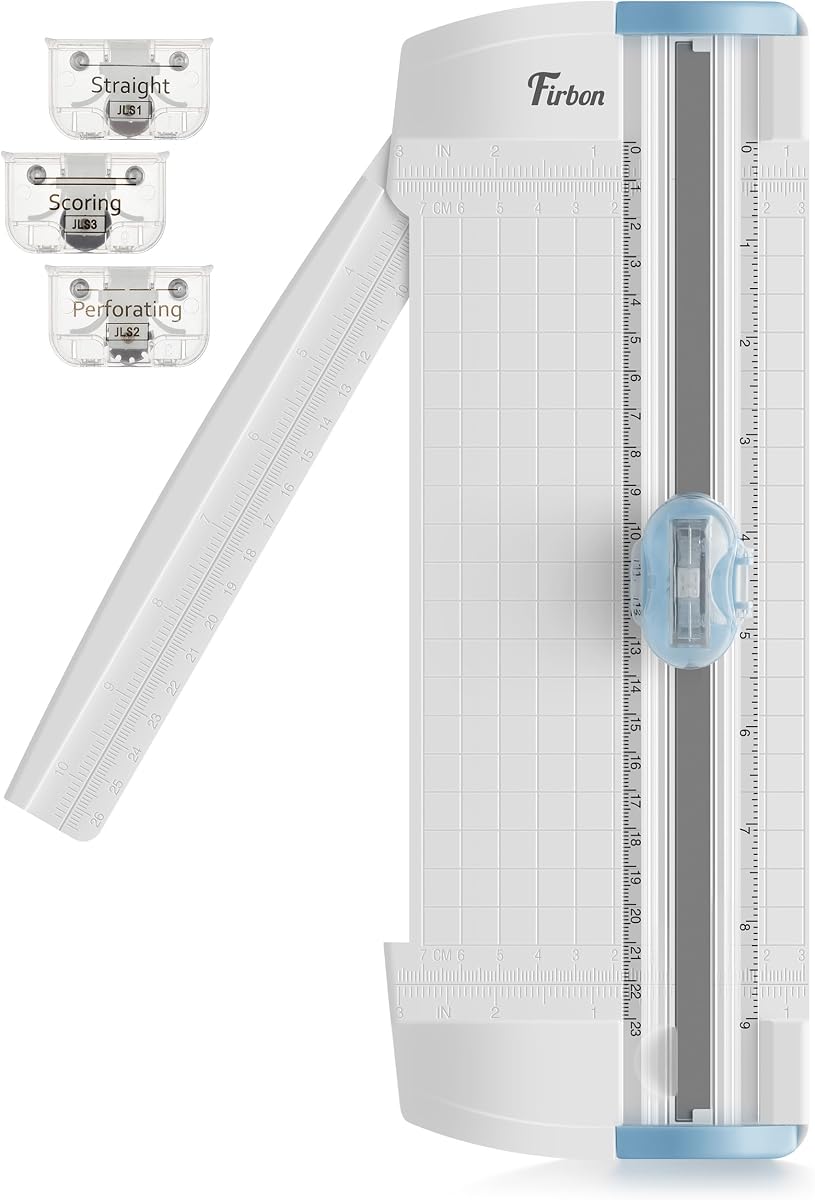


The Firbon A5 Paper Cutter is a compact guillotine-style trimmer built for users who want clean straight cuts without the footprint of a larger office cutter. Its 4.5 rating reflects a generally favorable balance of cutting performance, measurement features, portability, and ease of use. The replaceable spring-loaded blade is the core of the design, allowing the cutting edge to be renewed instead of requiring replacement of the entire unit.
We may earn a commission when you buy through this link, at no additional cost to you.
A maximum cutting width of 8.3 inches makes the tool well suited to A5 paper, photographs, cards, coupons, and lightweight laminated material. The listed capacity reaches eight sheets of 80 gsm paper, which is useful for small batches. A side ruler supports width measurements, while the angle plate covers 45 to 90 degrees. The centimeter and inch scales allow a crafter to work in either unit without relying on a separate measuring tool for every cut.
The obvious limitation is its relatively narrow cutting span. It is smaller than a conventional 12-inch paper trimmer, and the product description specifically asks buyers to confirm the dimensions before ordering. It also offers only straight cutting, so users who regularly need scoring or perforating must look at the three-in-one alternatives. These constraints do not diminish its usefulness for compact craft tables and A5-oriented workflows, but they define its scope clearly.
This Firbon model is a strong recommendation for scrapbookers, card makers, students, and home users who regularly trim standard A5 supplies and favor a simple guillotine mechanism. It offers a useful capacity, replaceable blade, and angle guide without the complexity of interchangeable functions. For larger sheets or advanced document finishing, choose a wider or multipurpose model instead.
The combination of a side ruler, centimeter and inch scales, and a 45-to-90-degree plate makes this cutter practical for repeated craft preparation. Align the material against the printed guide, set the desired width, and verify the angle before applying pressure.
Its small footprint suits a shared craft table, classroom, or home office where a large trimmer would occupy too much working space. The spring-loaded blade remains inactive until pressed, adding a useful layer of control around paper-cutting tasks.
We may earn a commission when you buy through this link, at no additional cost to you.
The Compact 12-Sheet Trimmer is a straightforward A5 paper cutter designed for coupons, labels, cardstock, scrapbooking, and routine office or home projects. Its 3.8 rating is the lowest among the listed group, so buyers should pay particular attention to current customer feedback and the product's construction before deciding. The supplied specification is concise, but it does highlight a useful combination of compact dimensions and high stated capacity.
We may earn a commission when you buy through this link, at no additional cost to you.
At 8.67 by 7.8 by 2 inches, the unit is shaped to occupy relatively little desk space. Its listed 12-sheet capacity exceeds the stated capacities of most competing models in this roundup. A carbon steel blade provides the cutting mechanism, while the broad application range includes ordinary paper, coupons, labels, cardstock, and scrapbooking materials. That makes it a potentially sensible choice for repetitive small-format trimming where changing the cutting tool often would be inconvenient.
The main drawback is the limited information supplied about its measurement system, safety mechanisms, base stability, and blade replacement process. The rating also suggests that some buyers may have encountered issues not captured in the short description. Buyers who depend on a transparent cutting guide, integrated ruler, or clearly documented safety system should review the live listing closely and consider a more fully specified alternative.
Despite those concerns, this trimmer is worth examining when sheet capacity and compact size matter more than elaborate functions. It may serve casual users well for coupons, labels, and small craft batches. For advanced card making or projects that require scoring, perforating, and highly visible measurement markings, one of the three-in-one models offers a clearer feature set.
The stated ability to cut up to 12 sheets gives this model an advantage for processing small stacks of coupons or cardstock. Always align the stack carefully and confirm the machine's material limits before making a full-capacity cut.
Its compact 8.67-by-7.8-inch body is suitable for desks, craft corners, and shared work areas. The trade-off is that it focuses on straight cutting rather than providing scoring, perforating, or elaborate angle features.
We may earn a commission when you buy through this link, at no additional cost to you.
The Firbon 3-in-1 A5 is designed for users who want more than a single straight cut. It combines a paper cutter, scorer, and perforator in one compact 9-inch format. Its 4.1 rating reflects a versatile feature set and useful measurement system, although it does not lead the group in customer rating. The three operating modes make it especially relevant for card making, gift packaging, origami, educational materials, and invitations.
We may earn a commission when you buy through this link, at no additional cost to you.
Sharp steel blades support straight cutting, scoring, and perforating. The stated maximum is six sheets of 70 gsm paper at once, with the product information advising firm downward pressure for optimal performance. A hidden side ruler, alignment grid, and inch-and-centimeter marks help position material accurately. The blade carriage is designed for quick changes, and storage built into the back helps keep spare blades organized and reduces the chance of misplacing them.
Its cutting width is capped at 9 inches, explicitly excluding oversized paper. That limitation is reasonable for an A5-focused model but means it cannot replace a full-size A3 or A4 trimmer. The six-sheet capacity is also lower than the eight- or twelve-sheet figures stated for some alternatives. Users should also understand that the cleanest result depends on pressing the cutting head down firmly rather than using a light, partial stroke.
This is a compelling choice for crafters who regularly score folds, produce tear-off coupon edges, or need multiple finishing operations without separate desktop tools. It is less compelling for someone whose only requirement is fast straight trimming of thicker stacks. For the stated multi-function purpose, however, the 3-in-1 design offers excellent utility in a compact package.
Straight cuts, scored folds, and perforations are available from one housing, which simplifies card-making and packaging workflows. Interchangeable functions are especially valuable when a project mixes several paper finishes.
The alignment grid, hidden side ruler, and dual-unit marks make it easier to reproduce dimensions accurately. Measure the intended section first, mark it on the grid, and verify the alignment before operating the selected blade.
We may earn a commission when you buy through this link, at no additional cost to you.
The Paper Cutter Slider A5 offers a straightforward guillotine trimmer in a particularly compact format. Its 10.6 by 3.3 by 1-inch body is designed for A5 paper, photos, light cardstock, coupons, labels, and other lightweight crafting materials. The 4.2 rating and straightforward feature set position it as a practical choice for a small desk, dorm room, classroom, or portable craft kit.
We may earn a commission when you buy through this link, at no additional cost to you.
The cutting area reaches 8.7 by 2.4 inches, which covers the dimensions of many common A5-related materials. A sharp steel blade is intended to produce straight edges without tearing, raggedness, or skew. Measurement markings appear along the base, and the cutting grid gives users a visible reference for alignment. These features matter more than they might appear because a stable, repeatable reference is often the difference between two evenly sized card panels and two frustratingly mismatched pieces.
Safety is a clear priority. A secure blade lock immobilizes the cutting edge during storage or transport, while a protective guard reduces the chance of accidental finger contact. The sturdy base is another positive for straight cuts. On the other hand, the tool is limited to straight cutting and is positioned for paper and light cardstock rather than heavy board or thick laminated material.
The Paper Cutter Slider A5 is a strong pick for budget-conscious buyers who want a dedicated small-format trimmer and value safe storage. It is less appropriate for users who expect scoring, perforating, or high-volume cutting of varied media. For light A5 crafting, those focused capabilities make it a compelling, space-efficient choice.
A locking blade and protective guard are particularly useful around children, shared desks, and transport cases. Lock the cutter when it is not in use and keep the cutting path clear during operation.
The base ruler and cutting grid support accurate alignment without adding bulk. The 8.7-inch cutting length is appropriate for A5 sheets and many common card-making components, while the 2.4-inch cutting depth suits narrow strips.
We may earn a commission when you buy through this link, at no additional cost to you.
The Firbon A4 Paper Cutter is technically larger than a dedicated A5 trimmer, but that extra width makes it a strong choice for A5 crafters who occasionally need to trim wider components. It holds a 4.6 rating and combines a 12-inch cutting span, a ten-sheet 80 gsm capacity, an extended ruler, and an angle plate. It is especially attractive to users who want a single trimmer for A3, A4, and A5 paper.
We may earn a commission when you buy through this link, at no additional cost to you.
A printed cutting line helps guide the blade without dragging, and the replaceable blade means a dull edge does not require replacing the complete trimmer. The 45-to-90-degree measuring plate supports both square and angled cuts, while centimeter and inch scales accommodate different measurement preferences. The listed material range includes photos, cards, and laminated material within 1.5 millimeters, making it more adaptable than a basic craft trimmer.
The main compromise is footprint. Compared with the 8.3-inch Firbon A5 model, this cutter takes up more desk space and is not as focused on portability. It also offers only straight cutting, so it cannot replace a dedicated scorer or perforator. The product information notes that cutting fewer sheets can prolong blade life, which is sensible advice for preserving performance and avoiding unnecessary material load.
Choose this model if a 4.6 rating, wide capacity, replaceable blade, and angle-cutting support are your priorities and desk space is not a major concern. It is a versatile home, school, or office cutter that can serve A5 needs while providing a valuable margin for larger sheets.
The 12-inch span is a major advantage when an A5 project includes wide mats, album pages, or pieces cut from larger stock. It provides more flexibility than a model designed strictly around a small portable footprint.
Maintaining a sharp cutting edge is essential for smooth paper edges, and the replaceable-blade design simplifies that upkeep. Avoid routinely overloading the cutter and remove debris from the cutting path to help the blade travel freely.
We may earn a commission when you buy through this link, at no additional cost to you.
The Evteck A4 Slider Trimmer takes a different approach from a spring-loaded guillotine by using a transparent cutting wire. Its 4.5 rating suggests that many users appreciate the smooth, low-resistance cutting action. The design is aimed at school, home, and office users who need to trim A3, A4, and A5 paper as well as photos, cards, decals, labels, light cardboard, and cardstock.
We may earn a commission when you buy through this link, at no additional cost to you.
Its 14.17 by 5.90 by 0.78-inch body is larger than the most compact A5 units, but that size creates a broad cutting area. A 45-to-90-degree angle plate and centimeter-and-inch scale help control both dimensions and angles. The transparent wire provides a visible cutting line, allowing the operator to follow the edge of the material without the blade carriage obscuring the cut.
Stability receives particular attention in the design. Six round nonslip pads are fitted to the underside to reduce movement during a cut, including when the trimmer is used on glass. The wire operates only when pressed, adding a practical safety behavior. The trade-off is that the transparent cutting wire can collect paper fibers or adhesive residue, so regular cleaning will help maintain smooth movement.
This model is well suited to households, classrooms, and small offices that want broad media compatibility and confident straight cuts. Those needing a highly portable A5-only tool may prefer a smaller guillotine, while those wanting scoring and perforating should choose a three-in-one model. For straightforward wire-guided trimming, the Evteck provides a stable, approachable alternative.
Six padded contact points help keep the trimmer from shifting as the carriage moves. A stable base is essential because any movement can change the cut line, particularly when working with long strips or narrow pieces.
The transparent cutting wire makes the blade path visible across the material. This can help users follow the edge consistently, although regular inspection and gentle cleaning will preserve smooth travel.
We may earn a commission when you buy through this link, at no additional cost to you.
The Fiskars SureCut Deluxe stands out as the premium option in this collection, pairing a 4.7 rating with a sophisticated straight-cut system. Its defining feature is SureCut technology, which uses a stainless steel wire cut line to produce precise edges. The TripleTrack system interlocks the blade and rail, reducing the chance of curved or wobbly cuts when paper is fed through the carriage.
We may earn a commission when you buy through this link, at no additional cost to you.
Straight-cut performance is only part of the design. The 6.0 mm arm extends to 15.6 inches, allowing the cutter to handle various material widths while remaining portable. A high-profile carriage provides an easier grip than many low-profile competitors, and rubberized feet improve stability while protecting the underlying work surface. These details may seem subtle during normal use, but they influence control, consistency, and overall comfort.
The primary limitation is functional rather than dimensional. The SureCut Deluxe focuses on straight trimming and does not include scoring or perforating, so a card maker with several finishing needs should consider a three-in-one model. It also belongs to a higher product tier, making it more of an investment than a basic craft purchase. Nevertheless, for users who repeatedly cut paper and want a stable, dedicated tool, its engineering provides clear value.
This is the strongest premium recommendation for buyers who prioritize consistent straight edges, smooth carriage movement, and comfortable handling. It suits home studios, school projects, scrapbooking, photo trimming, and office preparation. Those wanting a portable multi-function A5 device may prefer the Firbon 3-in-1, but the Fiskars is the stronger dedicated cutter for precision-focused work.
The interlocking blade-and-rail design supports a straighter travel path than a loosely supported sliding arm. That stability is valuable when repeatedly trimming card panels, photos, or narrow paper strips.
The raised carriage offers a natural grip and gives the operator better control. Rubberized feet keep the base stable and help protect the desktop, improving the overall experience of repeated trimming.
We may earn a commission when you buy through this link, at no additional cost to you.
The Three-in-One A5 Trimmer combines straight cutting, scoring, and perforating in a compact package. Its 4.1 rating is comparable to the other multipurpose option in the list, and its defining distinction is the use of three separate steel blades identified as JLS1, JLS2, and JLS3. This dedicated arrangement makes it especially suitable for documents, card making, folding projects, scrapbooks, and gift packaging.
We may earn a commission when you buy through this link, at no additional cost to you.
Measurement support is unusually thorough. The trimmer includes a transparent ruler, a hidden side ruler, a 1-centimeter grid, and dual inch-and-centimeter markings. The maximum horizontal cutting length is 23 centimeters, giving users several references for planning small craft sections. The steel blades can cut up to six sheets of 70 gsm paper and are designed to avoid jagged edges when used correctly.
Its spring-loaded blades remain hidden inside the case and activate only when pressed and slid, which is a sensible design around children and adults. Rear compartments store spare blades, and the blade holder opens for replacement. The limitation is that the 23-centimeter width is shorter than the 9-inch figure used by many competing A5 models, and six sheets is not a high stack capacity. It is a focused finishing tool rather than a general large-format cutter.
Buy this model when clean scoring and perforation are more important than maximum paper width. It reduces the need to keep separate handheld tools for common card-making tasks and provides an organized way to switch functions. For larger A5 sheets or higher stack volumes, a nine-inch three-in-one unit may be a better fit.
Separate cutting, scoring, and perforating blades let users select the appropriate tool without forcing one function to imitate another. This is useful for projects that combine crisp edges with controlled folds or tear-off lines.
Two rear compartments organize spare blades and reduce the chance of misplaced accessories. The openable blade holder supports quick, organized changes when moving from one paper-finishing task to another.
We may earn a commission when you buy through this link, at no additional cost to you.
The Firbon Black A5 Bundle combines a compact guillotine cutter with five replacement blades, creating one of the most complete maintenance-oriented options in the roundup. It has a 5.0 rating, the highest listed score, and uses the same core cutting approach as the smaller Firbon A5 model. The included refills are particularly useful for frequent scrapbookers, teachers, and craft studios.
We may earn a commission when you buy through this link, at no additional cost to you.
The cutter uses a sharp spring-loaded blade and a side ruler for precision trimming. It can cut A3, A4, and A5 paper, photos, cards, and laminated material within 1.5 millimeters, with a stated maximum of eight sheets of 80 gsm paper. A 45-to-90-degree angle plate and centimeter-and-inch scale make it useful beyond basic rectangular cuts. The replaceable design also means blade life can be managed without discarding the main tool.
The bundle's extra blades are both its main attraction and a possible source of redundancy. A user who cuts only a few pieces each month may not need five replacement blades, and the package offers no scoring or perforating function. Buyers who want a single all-purpose paper-finishing device may prefer a three-in-one model. Still, for a user focused on straight guillotine cuts who values ongoing blade availability, the bundle is unusually practical.
This is an excellent recommendation for regular scrapbookers, invitation makers, and classroom users who value maintenance readiness alongside a compact footprint. The 5.0 rating, eight-sheet capacity, replaceable blade, and included refills create a compelling package. It is less appropriate for projects centered on folds and perforations, where a scoring and perforating cutter would be more useful.
Having several replacement blades on hand reduces interruptions when an edge becomes blunt. It also makes the bundle well suited to shared craft environments where multiple users may need quick blade changes.
The side ruler, dual-unit scale, and angle plate provide useful control over both dimensions and angles. Consistent alignment and steady pressure are key to obtaining a clean, repeatable cut.
We may earn a commission when you buy through this link, at no additional cost to you.
The Nine-Inch Portable Trimmer is aimed at scrapbookers who want a compact cutting tool with a useful 9-inch span. Its 4.2 rating places it among the solidly rated middle options, while the swing-out ruler, alignment grid, and dual-scale rule support careful preparation of paper components. The stated dimensions make the product easy to carry between a home, classroom, or community craft session.
We may earn a commission when you buy through this link, at no additional cost to you.
Paper capacity is specified in two ways: up to eight sheets at 80 gsm and up to ten sheets at 70 gsm. This dual figure gives a more practical view of performance than a single capacity claim because the weight of the material changes how the trimmer behaves. The 9-inch cutting length is appropriate for many A5 projects, photos, and scrapbook page elements while remaining less cumbersome than a large A4 or A3 machine.
The swing-out ruler is useful because it can make measurements and the cutting reference visible without requiring the user to handle a separate ruler for every step. The alignment grid helps with consistent placement. The main trade-off is that this is a single-function straight cutter, with no listed scoring or perforating capability. The supplied description also provides less detail about blade replacement and locking mechanisms than some competing products.
This trimmer is a good fit for portable scrapbooking setups and users who need straightforward A5-oriented cutting with reliable measurement aids. Consider a three-in-one model for invitations, handmade stationery, or gift packaging involving folds and tear strips. For straight paper trimming alone, its portability, dual-scale ruler, and flexible sheet capacity make it a practical choice.
The compact, lightweight construction is suited to a portable craft kit or shared workspace. Pack the trimmer on a flat surface with enough clear space around the cutting path to operate it safely.
The separate limits for 80 gsm and 70 gsm paper make it easier to understand expected performance by material weight. Use the lower figure as a guide when a clean cut matters, and avoid forcing beyond the stated capacity.
We may earn a commission when you buy through this link, at no additional cost to you.
The best A5 paper cutter for one person may not be ideal for another, so consider paper width, material type, required finishing functions, measurement aids, storage, and safety before choosing. A compact model is convenient for detailed crafts, while a wider cutter offers more flexibility for occasional larger sheets.
Cutting width determines which sheets and craft components fit beneath the blade. Models marketed for A5 commonly range from a narrow 8.3-inch span to approximately 9 inches, while wider A4-oriented trimmers may reach 12 inches or more. The stated width is the maximum usable cut, so check both the full length and the depth of the cutting area if you plan to trim narrow strips or smaller labels. A cutter that is too narrow may be inconvenient even when its blade is excellent.
Choose a span that comfortably accommodates your most common sheets with room to position the material. Wider is useful for album pages and mixed-size projects, while a focused A5 width is more portable.
Sheet capacity matters when trimming a small batch of identical pieces. The products in this guide list capacities ranging from six sheets to twelve sheets, and several express the result using paper weight such as 70 gsm or 80 gsm. A higher number can improve workflow for coupons, cards, and classroom handouts, but it should not be interpreted as permission to cut heavy cardstock in equally large stacks.
Prioritize the rated capacity for your typical paper weight. If clean edges matter more than speed, cutting fewer sheets can also reduce strain and support blade longevity.
A straight cutter is versatile for trimming edges and separating sections, but card makers often also need scored folds and perforated tear-off strips. Three-in-one tools add these functions through separate blades, allowing the user to switch between cutting, scoring, and perforating without keeping separate small implements nearby. Straight-only models are simpler and may be sufficient for photo cropping, coupon preparation, and basic scrapbooking.
Choose multipurpose functionality when your projects regularly involve custom cards, packaging, or stationery. Stick with a dedicated straight cutter if simplicity is the priority.
Precise paper projects depend on repeatable measurement. Look for a clear ruler, grid, dual centimeter and inch markings, and an alignment reference that remains visible during the cut. Some designs use a hidden side ruler, an extended ruler, a swing-out ruler, or a transparent cutting wire. Angle plates add another layer of usefulness by supporting cuts from 45 to 90 degrees, which is valuable for labels, corners, and decorative shapes.
Choose the system you can comfortably read and see. A well-placed grid can be more useful than a more advanced-looking tool with a blade that blocks your view.
A sharp blade is central to producing clean paper edges, and steel construction appears throughout the list. Replaceable blades are especially valuable for high-volume crafters because they extend the useful life of the cutter without requiring a new machine. Bundles that include spare refills can be convenient for busy classrooms and shared craft rooms. The supplied descriptions also mention spring-loaded, hidden, and press-to-operate mechanisms.
Look for a tool with a clear replacement process and stored or bundled extras when you expect regular use. Keep spare blades away from children and store them safely after use.
Paper cutters use exposed cutting edges even when the operating mechanism is designed to retract them. A spring-loaded blade that activates only under pressure, a blade lock for transport, a protective guard, and a stable base all reduce unnecessary risk. Nonslip feet or pads are particularly useful when applying force to thick stacks or on smooth surfaces. A larger carriage can also make a controlled stroke easier for users with limited hand strength.
Favor visible safety controls and a base that resists sliding. Store the cutter with the blade secured, and teach children to treat the cutting path as an active work area.
Compact A5 trimmers are easy to move and fit into small craft corners, while larger sliders provide broader cutting areas but need more desk space. Consider where the tool will live, whether it will be transported, and how often it will be used. The lightweight designs in this guide are especially attractive for students and people who work at shared tables. A larger model can still be portable, but its footprint may be less convenient for continuous use in a confined area.
Measure your available workspace before ordering. Favor a compact model for tight desks and a wider trimmer when the additional cutting area will be used regularly.
Spring-loaded guillotine cutters deliver a decisive downward stroke, while slider trimmers use a carriage and cutting wire or blade drawn along the material. The slider design can provide a visible cut line and smooth travel, whereas a guillotine is often appreciated for its straightforward operation. Both types need a stable base, clean path, and careful alignment. Three-in-one models may combine guillotine-style cutting with separate scoring and perforating mechanisms.
Choose the mechanism that matches your comfort and workspace. Test the operating motion in demonstrations or customer feedback, and prioritize visibility and control over unfamiliar mechanisms.
Before cutting, place the trimmer on a flat, stable surface and confirm that the cutting path is clear. Measure the desired section with the built-in ruler or grid, mark the dimensions in the appropriate unit, and check the alignment before operating the blade. Keep fingers outside the cutting path and use a clear, uncluttered area for each cut.
Align the paper carefully and apply steady pressure along the intended line. For spring-loaded models, press the cutting head fully and evenly rather than stopping partway through. For slider models, move the carriage in one controlled pass, and for three-in-one tools, select the correct straight-cutting, scoring, or perforating blade before beginning.
After use, retract or lock the blade, especially when children may access the tool. Remove paper scraps and adhesive residue from the guide and cutting wire with a soft brush or suitable cloth, but avoid immersing the tool or using excessive liquid. Store the trimmer flat, protect replaceable blades from damage, and replace a dull blade promptly to preserve clean results.
An A5 paper cutter is designed around a smaller cutting width, making it compact and convenient for cards, labels, photos, and small craft sheets. An A4 trimmer has a longer cutting span and can also handle A4 and sometimes A3 paper. The A5 model is usually easier to store, while the A4 model offers more flexibility for larger sheets.
It depends on the cardstock thickness and the cutter's stated limits. Several models list cardstock, photos, and light laminated materials among suitable materials, but capacity figures generally refer to standard-weight paper. Do not assume that the same number of sheets applies to heavier cardstock, and avoid exceeding the manufacturer's guidance.
It depends on the design and how it is used. Many guillotine-style A5 cutters use spring-loaded blades that remain hidden until the user presses the cutting head, while some also include blade locks or protective guards. No cutter should be treated as harmless, so hands must stay away from the cutting path and the tool should be stored securely.
A three-in-one cutter is useful when your projects regularly require scored folds or perforated tear-off lines in addition to straight cuts. It saves time and workspace by keeping those functions in one housing. If you mostly trim paper edges, photos, or plain card panels, a simpler straight cutter may be easier to maintain and more economical to own.
Sheet capacity indicates how many sheets of a stated paper weight the manufacturer says the cutter can handle at one time. The capacity may vary with paper weight, material stiffness, and cutting technique. A higher capacity is convenient for repetitive work, but cutting fewer sheets can preserve blade quality and may produce more consistent edges.
Use a flat cutting surface, make sure the trimmer cannot slide, and align the paper against the grid or printed reference. Check the measurement twice, keep the sheet flat, and move the blade or cutting head in a controlled pass. Dull blades and debris in the cutting path are common causes of dragging or uneven edges.
Some products in this guide explicitly list laminated material within a maximum thickness of 1.5 millimeters. That does not mean every model or every laminate is suitable. Check the individual specification and avoid stacking multiple laminated sheets unless the manufacturer specifically allows it.
Replace the blade when it begins dragging, crushing edges, or producing uneven cuts rather than waiting for it to fail completely. Frequency depends on paper volume, material type, and cutting habits. A model with replaceable blades and several refills is especially convenient for frequent crafters, teachers, and shared workspaces.
The Paper Cutter Slider A5 is the most budget-conscious selection, combining a compact footprint, integrated measuring grid, steel blade, and thoughtful safety controls. The Firbon Black A5 Bundle is the editor's choice for users who value a high-rated straight cutter, an eight-sheet capacity, angle support, and five included replacement blades. For a premium dedicated straight-cut tool, the Fiskars SureCut Deluxe stands out with its stainless steel cut line, TripleTrack system, and stable, comfortable design.
Prioritize the features your work actually requires. A compact guillotine is sufficient for basic trimming, a three-in-one model is valuable for card making and packaging, and a wider trimmer provides useful flexibility when A5 is only part of your paper range. Measurement visibility, stable construction, blade availability, and safe storage can matter more than a long specification list once the cutter is on the desk.
Before placing an order, review the current listing, recent customer feedback, dimensions, material limits, and included accessories. Product specifications and availability can change, and the right cutter ultimately depends on the paper formats and finishing tasks in your regular workflow.