
CORSAIR Vengeance 16GB DDR5 SODIMM
4.8Editor score
16GB single SODIMM module
Up to 5600MHz advertised speed
Intel XMP 3.0 profile
Our DDR5 Laptop RAM guide compares 10 top kits for capacity, speed, compatibility, latency, and reliable everyday performance in laptops and notebooks.
DDR5 laptop memory can give a compatible notebook more breathing room, smoother multitasking, and better performance when applications compete for limited resources. The right kit depends on processor support, slot configuration, rank organization, latency, and the amount of memory your workload actually needs.
This guide compares ten DDR5 SODIMM options based on capacity, advertised speed, timings, voltage, ECC configuration, rank, supported profiles, and intended laptop compatibility. It covers matched dual-module kits and single-module alternatives without assuming that the highest advertised frequency will run at full speed in every system.
The picks show that a balanced 32GB dual-channel kit is the most versatile upgrade, while a 16GB module can be useful for selective expansion. Read the laptop compatibility details carefully, check whether both memory slots are accessible, and remember that product prices and availability can change.
4.8Editor score

4.8Editor score

4.5Editor score
The comparison below highlights the capacity, module count, maximum advertised speed, and key configuration differences among all ten kits.




The Crucial CT2K16G56C46S5 is a 32GB DDR5 laptop memory kit composed of two matched 16GB SODIMM modules. It carries a 4.8 rating and stands out for offering 5600MHz, 5200MHz, or 4800MHz options while supporting both Intel XMP 3.0 and AMD EXPO profiles. That combination makes it a broadly appealing choice for a compatible modern notebook.
We may earn a commission when you buy through this link, at no additional cost to you.
Capacity is the kit's strongest feature. Thirty-two gigabytes gives demanding users room to run many browser tabs, office applications, communication tools, and background services without immediately pushing the laptop into its memory limit. Two matched modules can also support dual-channel operation when the laptop, processor, and firmware allow it, an arrangement that can improve practical performance compared with using a lone module.
The listed PC5-44800 rating corresponds to the advertised 5600MHz configuration, while the voltage is 1.1V. The modules are non-ECC, unbuffered-style consumer SODIMMs with a 262-pin layout and a 1Rx8 configuration, matching the form used by compatible DDR5 laptops. Crucial also states that the modules support XMP 3.0 and EXPO, although a notebook still has to recognize and apply the relevant profile.
The main qualification is that a laptop cannot create support for memory the platform cannot use. A machine designed for 4800MHz or 5200MHz may run this kit at its supported rate, and the maximum advertised frequency still depends on the CPU and BIOS. Buyers should also confirm that both SODIMM slots are accessible. With those conditions met, this is an excellent general-purpose 32GB kit for a new or upgraded DDR5 laptop.
For users who want capacity without choosing a very small single module, the Crucial kit is especially practical. Its two-module design provides a clear upgrade path, while the unusually broad platform-profile support makes it easier to consider across both Intel Core and AMD Ryzen 7000-based laptops. It is our overall pick because it balances usable capacity, competitive rated performance, and flexible compatibility without emphasizing one narrow use case.
A matched 32GB kit offers a useful balance of capacity and memory-channel utilization. It is particularly appropriate for users who regularly multitask, keep large project files open, or run applications that benefit from more available memory than a 16GB configuration can provide.
Support for Intel XMP 3.0 and AMD EXPO is valuable when a laptop can expose those settings. Remember that advertised speed is conditional: the processor, motherboard, BIOS, thermal design, and module profile all influence the frequency the system ultimately uses.
We may earn a commission when you buy through this link, at no additional cost to you.
The CORSAIR CMSX16GX5M1A5600C48 is a single 16GB DDR5 SODIMM rated at up to 5600MHz with CL48 timing. Its 4.8 rating makes it one of the strongest-rated products in this guide, while the single-module format offers a simple way to add memory to a compatible laptop that may not have two accessible slots.
We may earn a commission when you buy through this link, at no additional cost to you.
This kit is especially useful for a selective upgrade. Someone who currently has a small amount of memory, needs more capacity for office work, browsing, and general productivity, and prefers a straightforward single-module installation can find the format convenient. A matching module may be added later if the laptop supports the necessary hardware and the operating system addresses the full installed capacity.
CORSAIR describes the SODIMM as compatible with many Intel and AMD gaming and performance laptops, small-form-factor PCs, and Intel NUC kits. Installation typically requires only a screwdriver. The module includes an Intel XMP 3.0 profile, and CORSAIR states that compatible systems may select the maximum supported speed automatically, although the company's own disclaimer makes clear that full advertised performance depends on the rest of the system.
There are trade-offs. A single 16GB module does not create the same matched dual-channel configuration as a 2x16GB kit, and CL48 is less latency-focused than the CL40 option in this roundup. Maximum frequency may also be limited by the laptop's supported memory generation and CPU. Nevertheless, for a straightforward capacity expansion, this module delivers a highly rated and widely applicable package.
Our budget recommendation is best for buyers who know they can use only one memory slot or who want an uncomplicated first upgrade. It may not be the ideal choice for a gaming notebook designed to exploit matched dual-channel memory, but it remains a well-rated 16GB DDR5 SODIMM with broad compatibility and a straightforward installation process.
A single 16GB SODIMM avoids requiring two free slots to begin an upgrade. It also provides a natural way to preserve the existing module while adding capacity, provided the existing memory is compatible and the laptop can use the resulting combination.
The 262-pin SODIMM format targets modern DDR5 notebooks rather than desktop DIMMs or older DDR4 laptops. CORSAIR's compatibility emphasis makes the module relevant to many gaming and performance notebooks, compact PCs, and NUC-style systems that use the correct generation of memory.
We may earn a commission when you buy through this link, at no additional cost to you.
The TEAMGROUP TED532G5600C46ADC-S01 is a 32GB DDR5 laptop kit with two 16GB modules. It is specified at 5600MHz and PC5-44800 with CL46 latency, non-ECC unbuffered construction, 1.1V operation, and a 262-pin layout. Its 4.6 rating reflects a strong customer reception while leaving it slightly behind the two 4.8-rated products in the comparison.
We may earn a commission when you buy through this link, at no additional cost to you.
The kit's primary appeal is its straightforward combination of 32GB total capacity and a full 5600MHz specification. TEAMGROUP highlights the newer DDR5 structural design, efficient 1.1V working voltage, and on-die ECC. The latter is a feature built into the DDR5 architecture and should not be confused with the non-ECC designation of the modules or with platform-level ECC support for an entire laptop.
For a user moving beyond a basic 16GB configuration, the two 16GB modules are a meaningful upgrade. They can give a supported laptop more room for concurrent applications, larger working sets, and heavier productivity or creative workloads. A matched set also provides a more appropriate arrangement for systems designed to use dual-channel memory than a single module would.
The main limitation is that the supplied product information does not mention an Intel XMP 3.0 or AMD EXPO profile. That does not make the kit unsuitable, but users may need to rely on the laptop's standard JEDEC behavior rather than expecting manual profile selection. As with every 5600MHz kit here, the processor and laptop firmware determine whether that speed is available.
TEAMGROUP is a strong recommendation for someone seeking a conventional 32GB dual-module upgrade with a clearly stated 5600MHz specification, low operating voltage, and a listed lifetime warranty. It is less compelling for buyers who specifically want exposed XMP controls, but the core capacity and performance specifications are well suited to a modern performance notebook.
Thirty-two gigabytes is a practical target for users who keep many applications open or handle files that exceed comfortable single-task memory demands. The 2x16GB layout also gives compatible systems the opportunity to use two channels when their controllers and CPU support that arrangement.
The 1.1V operating specification aligns with standard DDR5 efficiency goals, while on-die ECC helps with internal memory-cell error management. These characteristics support stable operation, but they do not turn a consumer non-ECC SODIMM into a server-grade error-correcting memory module.
We may earn a commission when you buy through this link, at no additional cost to you.
The GIGASTONE 32GB kit provides two 16GB DDR5 SODIMM modules rated at 5600MHz and PC5-44800. It has a 4.7 rating, non-ECC unbuffered construction, a 262-pin layout, and a 1.1V operating voltage. The listed CL46-46-46-90 timing string gives buyers a more detailed view of the memory timings than a single CL number.
We may earn a commission when you buy through this link, at no additional cost to you.
GIGASTONE explicitly positions this product for DDR5 laptops, notebooks, and all-in-one computers rather than desktop systems. That focus is helpful because desktop DDR5 DIMMs and laptop DDR5 SODIMMs are not interchangeable. Buyers should also distinguish this kit from DDR4 laptop memory, as the physical and electrical specifications are different.
The 2x16GB arrangement is the most useful feature for a performance-oriented laptop upgrade. It offers 32GB of combined capacity and, when supported, can take advantage of dual-channel memory operation. The 5600MHz specification is competitive with the fastest advertised options in this guide, while the power-management integrated circuit is intended to improve power efficiency in portable systems.
The supplied information does not mention XMP 3.0 or EXPO profiles, so buyers should not assume that manual overclocking controls will be exposed by their notebook BIOS. Actual speed depends on CPU support, firmware, and the laptop manufacturer. A 4800MHz or 5200MHz laptop can still use DDR5 memory, but it may run the modules below their advertised peak.
This GIGASTONE kit is a convincing choice for a compatible DDR5 notebook that needs more memory and is driven by a processor capable of supporting the advertised data rate. Its detailed timing specification, integrated power management, and favorable rating make it practical for productivity users, creators, and multitaskers who want a straightforward matched pair rather than a single high-capacity module.
The CL46-46-46-90 sequence describes the principal memory timings. Lower latency can be beneficial in responsive workloads, although the laptop's memory controller, CPU, and automatic performance settings ultimately determine what users experience in normal applications.
A 262-pin SODIMM is the correct physical format for most modern DDR5 laptops. Desktop memory has different dimensions and electrical characteristics, so verify that the device uses removable DDR5 SODIMMs before ordering rather than relying only on the system's advertised memory generation.
We may earn a commission when you buy through this link, at no additional cost to you.
The G.SKILL F5-5600S4040A16GX2-RS combines two 16GB DDR5 SO-DIMMs for 32GB of capacity. Its advertised maximum rate is 5600MT/s with CL40-40-40-89 timings, operating voltage of 1.10V, and non-ECC unbuffered construction. The 4.5 rating is solid, although the kit's standout technical feature is its lower CL40 latency compared with the CL46 and CL48 options here.
We may earn a commission when you buy through this link, at no additional cost to you.
G.SKILL includes a JEDEC default profile and an Intel XMP 3.0 memory overclock profile. The kit is designed to boot at the JEDEC default speed with compatible hardware under default BIOS settings, while the faster profile may require appropriate firmware configuration. G.SKILL also advises consulting its qualified vendor list or RAM Configurator for specific hardware compatibility.
The CL40 timing can make this option appealing to buyers who place value on efficiency and responsiveness within the 5600MT/s class. It combines that with a full 32GB capacity and a matched kit design. As a result, it suits demanding users who want both substantial memory and one of the more latency-conscious specifications in this comparison.
The most important caution is also the one G.SKILL makes explicitly: memory kits are sold as matched sets and should not be mixed with other kits. Combining independently purchased modules can cause instability or failure, even when their headline capacities and speeds appear similar. Maximum performance also depends on the CPU and motherboard, and the manufacturer warns that misuse outside its recommendations can result in lower speeds or instability.
We label this kit the premium pick because it combines a full 32GB matched configuration with the lowest listed primary latency among the 5600-class products in the roundup. It is best for a compatible performance laptop whose owner wants exposed profile options and values tighter timings. For a system that cannot access XMP settings, the default JEDEC behavior remains important, and the buyer should verify support before ordering.
CL40 is the key specification that separates this Ripjaws kit from many 5600-class competitors. It can be attractive for responsive computing, but users should set realistic expectations because memory latency in a laptop also depends on the CPU and memory controller.
G.SKILL's advice to use the modules together is important for stability. The kit also supports default JEDEC operation, providing a conservative starting point when a BIOS does not expose XMP 3.0 or when the installed processor cannot sustain the maximum advertised rate.
We may earn a commission when you buy through this link, at no additional cost to you.
The CORSAIR Vengeance 32GB DDR5 SODIMM kit includes two matched 16GB modules with an advertised speed of up to 5600MHz and CL48 timing. It carries a 4.7 rating and targets a broad range of Intel and AMD gaming and performance laptops, compact PCs, and NUC kits using the standard SODIMM format.
We may earn a commission when you buy through this link, at no additional cost to you.
Thirty-two gigabytes makes this a general-purpose upgrade for users who have outgrown a smaller memory configuration. The matched module pair can also exploit dual-channel operation in compatible notebooks. That is useful for gaming, content creation, development, and heavy multitasking, where a constrained memory subsystem can lead to stuttering, sluggish application switching, or an increase in disk-based virtual memory use.
The kit's XMP 3.0 compatibility and automatic maximum-speed selection are convenient features. CORSAIR says compatible systems can set the module to the highest speed it supports without requiring manual BIOS adjustment, which reduces setup complexity for users who do not routinely tune memory. Installation generally requires only a screwdriver, provided the laptop exposes its memory slots.
CL48 is the principal technical trade-off. It is less aggressive than the CL40 timing of the G.SKILL option, and real-world differences may be small in many productivity tasks. More importantly, the disclaimer is explicit: maximum speed depends on the rest of the system and can require overclocking or BIOS adjustments. A processor or firmware limited to a lower JEDEC rate will remain the deciding factor.
This CORSAIR kit is a straightforward choice for buyers who want a full 32GB pair and broad laptop compatibility without taking a premium-timing approach. It is especially attractive for gaming and performance notebooks that support XMP 3.0. The recommendation is conditional on confirmed system support, but within that requirement it offers a well-regarded and uncomplicated memory upgrade.
A 32GB matched kit gives modern applications more room to remain resident in memory. In a compatible notebook, dual-channel operation can also improve memory bandwidth, making the upgrade more meaningful than simply adding capacity when both are possible.
Automatic speed selection can make installation easier because the laptop may apply a supported profile after recognizing the modules. It should not be confused with guaranteed 5600MHz operation, since the platform's supported memory speed remains the upper limit.
We may earn a commission when you buy through this link, at no additional cost to you.
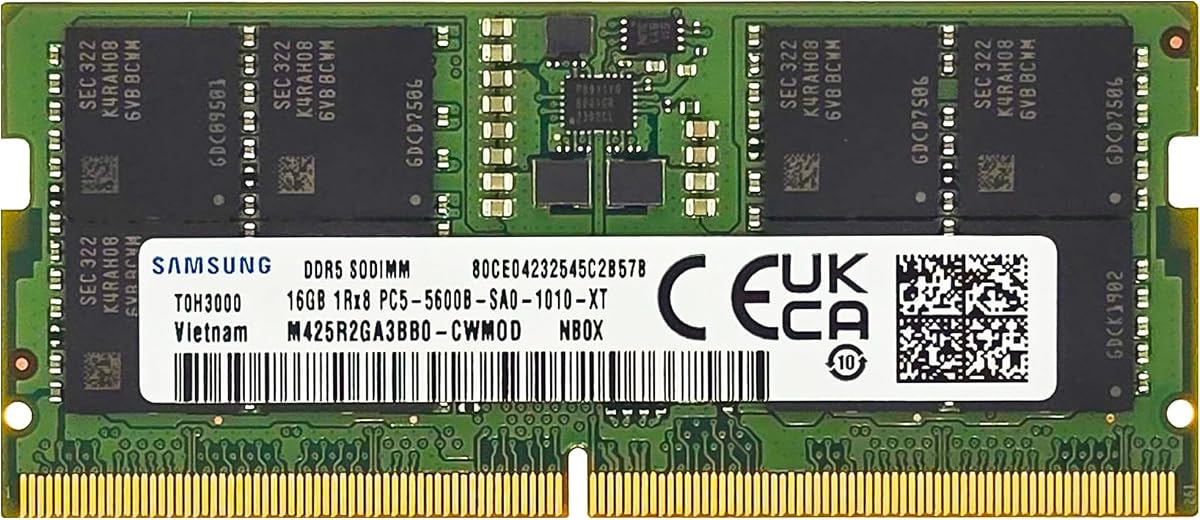
The Samsung M425R2GA3BB0-CWM is a single 16GB DDR5 SO-DIMM rated up to 5600MHz with PC5-44800 bandwidth and CL46 timing. It uses a 1Rx8 single-rank organization, standard 1.1V operation, non-ECC unbuffered construction, and a 262-pin package. Its 4.5 rating places it among the well-regarded options in the roundup.
We may earn a commission when you buy through this link, at no additional cost to you.
As a single module, it is a practical expansion option for compatible laptops with only one accessible SODIMM bay. A user who wants more working memory can install this module without sourcing a matched pair. That convenience comes at a potential bandwidth cost in systems designed for dual-channel operation, because a single module cannot populate both channels.
The product information identifies compatibility with select laptop and notebook computers, making model-level verification important. A laptop must use DDR5 SO-DIMMs and must support the appropriate capacity, organization, and speed. The part number is also useful when checking system documentation because notebook manufacturers sometimes list specific supported memory configurations.
Samsung's module offers a conventional balance of 16GB capacity, CL46 latency, and an advertised 5600MHz data rate. The 1Rx8 organization is clearly stated, allowing buyers to compare it with their existing memory if they intend to run two modules. As always, combining an existing module and a new module can reduce stability if they differ substantially in speed, timings, or organization.
The Samsung module is best recommended as a targeted capacity upgrade rather than a universal high-bandwidth solution. It makes sense for a compatible notebook that has one open slot, needs more memory, and does not require maximum dual-channel bandwidth. Buyers who have two free slots and want the best overall performance should generally favor a matched 32GB pair.
Adding 16GB can help a notebook handle more applications and larger working sets without constantly relying on slower storage for virtual memory. The benefit is especially noticeable when the starting configuration has very limited capacity.
The 1Rx8 designation identifies a single-rank x8 memory organization. It gives technically informed buyers a way to compare modules, but the laptop manufacturer remains the best authority on whether combining it with another module is supported and stable.
We may earn a commission when you buy through this link, at no additional cost to you.
This Samsung offering consists of two 16GB DDR5 SODIMM modules totaling 32GB. It is specified at 5600MHz and PC5-44800 with CL46 timing, a 1Rx8 single-rank organization, non-ECC unbuffered construction, 1.1V operation, and a 262-pin layout. The listed model is M425R2GA3BB0-CWM, with several equivalent part numbers potentially supplied.
We may earn a commission when you buy through this link, at no additional cost to you.
The pair is a natural choice for compatible laptops that expose two memory slots and can benefit from dual-channel operation. Thirty-two gigabytes provides generous working space for browsers, communication applications, office suites, creative tools, and development environments. It is also a more balanced upgrade than placing 16GB in one slot while leaving the other unused.
Samsung's stated use of interchangeable part numbers is worth noting because the physical label on a delivered module may not exactly match the primary model in the listing. The provided information says the alternatives have identical specifications and performance, which helps explain why several identifiers may appear. Buyers should still confirm the specifications and compatibility rather than relying on appearance alone.
No customer rating is available for this listing, so it does not have the same visible review history as the more established products. That is an important difference in a comparison because customer feedback can provide useful context about packaging, installation, and real-world behavior. The technical specification is clear, but prospective buyers should look for current product reviews and verify the exact warranty and return terms.
This Samsung kit is a credible 32GB option for a select compatible laptop, especially for buyers who prefer a familiar memory brand and do not need exposed overclocking profiles. Its standard speed and latency specifications are sensible rather than aggressively tuned. It is best chosen after checking the notebook's support list and confirming that the supplied modules carry the expected equivalent part number.
The matched pair is preferable when a laptop supports two channels. It can improve available bandwidth while providing the full 32GB capacity, making the kit suitable for users who switch frequently among several demanding applications.
The listing identifies the primary Samsung part number and possible equivalents. Because delivered components can carry alternate but specification-identical labels, comparing module numbers should focus on capacity, speed, timings, voltage, rank, and form factor rather than expecting one printed identifier.
We may earn a commission when you buy through this link, at no additional cost to you.
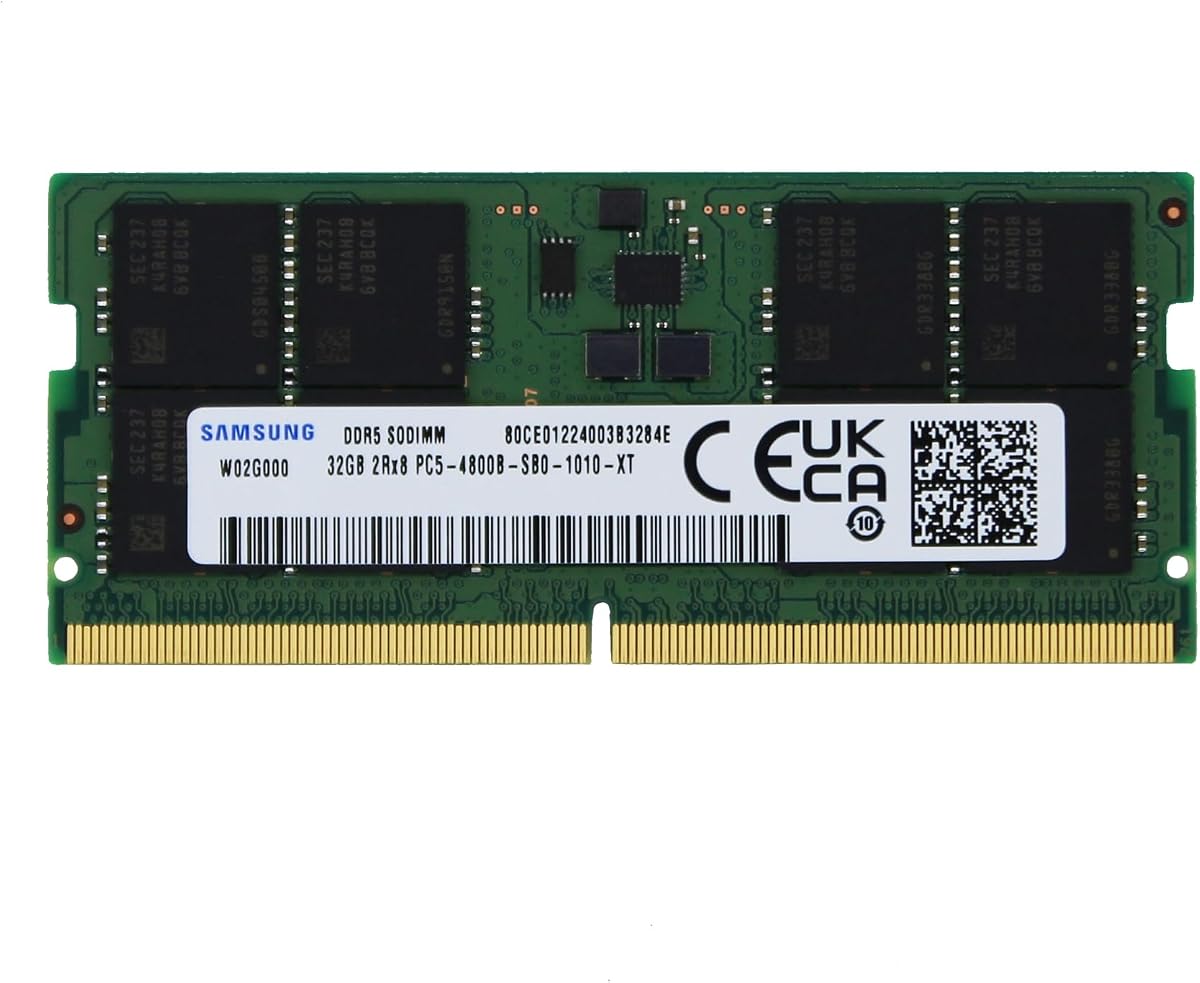
The Samsung M425R4GA3BB0-CQK puts 32GB of DDR5 memory into one 262-pin SODIMM. It operates at 4800MHz with PC5-38400 bandwidth, CL40 latency, 2Rx8 dual-rank organization, and 1.1V power. The product has a 5.0 rating, the highest numerical customer score among the listings with an available rating.
We may earn a commission when you buy through this link, at no additional cost to you.
Its defining benefit is high density in a single module. That is valuable in laptops that expose only one replaceable memory slot or whose design does not support two large modules. A single 32GB module can also simplify installation compared with a matched pair and gives a compatible platform substantial working memory in one slot.
Dual-rank 2Rx8 is a meaningful technical characteristic. It tells buyers that each module contains two memory ranks organized as x8 devices, which can provide different internal behavior from a single-rank module. At the same time, the advertised 4800MHz is lower than the 5600MHz maximum used by many competing kits, and actual throughput still depends on the laptop's memory controller.
The single-module format is the primary compromise. A compatible dual-channel laptop may gain more bandwidth from two matched modules than from one high-density 32GB SODIMM. The CL40 timing is attractive, but lower frequency and single-module operation place this product in a different performance profile from the top dual-module kits. The 5.0 rating suggests strong customer satisfaction, although it remains just one listing-level signal.
This Samsung module is best for select notebooks that need a large capacity increase but provide only one practical slot. It is less suitable when the goal is maximum memory bandwidth and the laptop can accept a 2x16GB pair. Confirming the system's maximum module capacity and supported memory organization is essential before making the purchase.
A 32GB SODIMM can be especially useful in compact notebooks with a single accessible memory bay. It delivers substantial capacity without requiring two modules, although users give up the opportunity to populate two separate channels.
The 2Rx8 label indicates a dual-rank x8 module and helps distinguish this product from single-rank alternatives. Compatibility depends on the laptop, so its support documentation should be checked for accepted capacity and organization.
We may earn a commission when you buy through this link, at no additional cost to you.
The Samsung M425R1GB4PB0-CWM listing contains two 8GB DDR5 SODIMM modules for 16GB of total memory. Both are specified at up to 5600MHz and PC5-44800 with CL46 latency, a 1Rx16 single-rank organization, non-ECC unbuffered construction, and 1.1V power. No customer rating is available for this particular listing.
We may earn a commission when you buy through this link, at no additional cost to you.
Using two 8GB modules can give a compatible laptop a dual-channel configuration without requiring a larger total memory kit. That arrangement may improve memory bandwidth compared with a single module, particularly in systems with integrated graphics that share system memory. It can also be a straightforward way to replace an existing low-capacity pair.
The principal limitation is total capacity. Sixteen gigabytes remains adequate for many mainstream tasks, but demanding users running many applications, large creative projects, or memory-intensive software may prefer 32GB or more. This kit is therefore more compelling as a balanced, affordable entry-level expansion than as a maximum-capacity solution.
The 1Rx16 organization deserves attention when comparing this set with the 1Rx8 modules elsewhere in the guide. Some laptop platforms have specific memory requirements, and the manufacturer or service manual remains the best source for supported configurations. The listing also notes that genuine Samsung modules may have equivalent part numbers, so users should compare the full technical details on the received label.
This Samsung 2x8GB kit is best for a compatible laptop seeking dual-channel operation and a modest increase from very low memory capacity. It may be a good fit for light productivity, study, and general browsing, but buyers should consider a 32GB option if application demands are already growing. Current customer feedback should also be reviewed because this listing has no visible numerical rating.
A 2x8GB set can populate both memory channels in a compatible notebook. That may help bandwidth-sensitive tasks while keeping total capacity within a more modest level for everyday work.
Capacity limits become noticeable when applications move substantial data, many browser tabs remain open, or virtualized and creative workloads coexist. Those users should prioritize a 32GB matched kit rather than selecting this configuration solely for its advertised frequency.
We may earn a commission when you buy through this link, at no additional cost to you.
Choosing DDR5 laptop memory requires balancing physical compatibility, usable capacity, channel configuration, processor limits, and the laptop's available memory slots.
A DDR5 laptop requires 262-pin DDR5 SO-DIMM modules, which are physically and electrically different from desktop DDR5 DIMMs and DDR4 laptop memory. Check the laptop's service manual, manufacturer specification, or a reliable compatibility list before buying. Neither the processor brand nor a broad DDR5 label guarantees that a particular module will fit, because laptop manufacturers can impose restrictions on capacity, rank organization, and supported speeds.
Eight gigabytes per module is a basic starting point, 16GB modules are much more versatile, and 32GB modules suit machines with a single accessible slot. Total capacity matters more than module count when a laptop's workload includes many applications, large files, browser sessions, or development environments. A matched 2x16GB kit provides 32GB and can use two channels, while a single 32GB module simplifies installation but gives up that same channel opportunity.
DDR5 modules in this roundup advertise rates up to 4800MHz or 5600MHz, but the processor and laptop firmware determine the highest speed actually available. A newer CPU does not automatically guarantee the maximum rate in every chassis, and some laptop manufacturers lock memory to a conservative JEDEC setting. Look for the supported memory speed in the system's specifications and avoid assuming that an advertised module speed will be achieved simply because the kit contains an XMP or EXPO profile.
Single-rank and dual-rank modules organize memory internally in different ways, while a matched pair can populate the laptop's dual channels. The 1Rx8 and 1Rx16 labels distinguish rank organizations, and the 2Rx8 design identifies a dual-rank module. These details can influence compatibility and performance, so buyers should compare the new modules with their existing memory and check the laptop manufacturer's supported configurations.
CAS latency appears in the product naming as CL40, CL46, or CL48. Lower CL values generally indicate a more aggressive timing specification, although effective memory performance also depends on the processor, controller, and workload. The G.SKILL Ripjaws kit has the lowest primary latency here, while the CL46 kits offer a middle option and the CORSAIR CL48 products emphasize flexible compatibility and speed selection rather than minimum latency.
Intel XMP 3.0 and AMD EXPO profiles can expose faster memory settings when the laptop BIOS supports them. Some modules include both, while others list only a JEDEC default profile or provide no explicit profile information. Automatic speed selection can make installation convenient, while manual profiles can provide access to higher rated frequencies. If your laptop does not expose these controls, prioritize straightforward JEDEC operation and verified compatibility.
Not every laptop exposes both memory slots, and some thin notebooks have soldered memory that cannot be replaced. A 2x16GB kit requires two accessible slots, while a single 16GB or 32GB module may be the only practical option. Before ordering, determine the maximum number of removable modules, the accepted capacity per slot, and whether the system supports the proposed module organization. Installation usually requires a screwdriver, shutdown, and careful handling of the memory contacts.
The modules in this guide use the standard 1.1V DDR5 operating specification, and some mention on-die ECC or an integrated power-management circuit. On-die ECC is an internal DDR5 feature and should not be confused with full system-level ECC memory, which is common in workstation and server-class laptops. For portable use, efficient operation, stable firmware behavior, and a manufacturer warranty are often more valuable than a small difference in rated speed.
Before installing memory, shut down the laptop completely and disconnect its charger. Open the bottom panel according to the manufacturer's instructions, locate the SODIMM slots, and note the existing module arrangement. Remove only the retention clips and modules recommended by the service guide, and avoid touching the gold connector contacts.
Insert each new module at the correct angle and press it evenly until the retention clips close. If a latch does not engage easily, do not force it; reseat the module and verify that its notch aligns with the slot. Once the kit is installed, reconnect the charger, boot the system, and confirm that the BIOS or operating system reports the expected total memory capacity.
If the laptop fails to boot, power it down and remove the power cable, then check that both modules are fully seated and that the original compatible memory can boot on its own. If the system starts but reports a reduced speed, that may reflect the processor or firmware's supported rate rather than a defective module. Use the manufacturer's diagnostics, update the BIOS when appropriate, and avoid changing unrelated performance settings until stable operation is confirmed.
For heavy multitasking, large files, development, creative applications, and many browser tabs, 32GB usually provides more useful headroom than 16GB. A 2x16GB matched kit can also use dual channels when the laptop supports that arrangement. For light productivity and browsing, 16GB may be sufficient, so the best capacity depends on the applications and available slots rather than one universal figure.
A DDR5 laptop may run 5600MHz memory, but only if its processor, motherboard, firmware, and manufacturer specifications support that rate. Some systems will use a lower JEDEC speed, while others may expose XMP 3.0 or EXPO controls. Check the laptop's supported memory specifications and the module's compatibility requirements before expecting the advertised maximum frequency.
Usually, a laptop with two memory channels can operate with one module, although it will not populate both channels and may therefore deliver less memory bandwidth. Some laptop designs also restrict the maximum capacity or organization of a single module. A matched 2x16GB pair is generally preferable when both slots are available and supported.
No. Laptop DDR5 uses 262-pin SO-DIMM modules, while desktop DDR5 generally uses longer DIMMs with a different pin count and physical layout. They are not interchangeable. You also need DDR5 rather than DDR4 because the notch positions, electrical standards, and internal organization differ.
No. On-die ECC is a feature built into DDR5 chips and handles certain internal errors, but it is not the same as end-to-end platform ECC that reports and corrects errors across the complete memory system. The products in this guide are specified as non-ECC, so they should not be treated as substitutes for workstation or server-class ECC memory.
A matched kit is generally safer and more predictable because its modules are designed and tested together. Independently purchased modules may use different speed profiles, timings, rank organizations, or component revisions. Even if the headline specifications look identical, combining unmatched modules can reduce stability or prevent the laptop from reaching its intended performance.
Check the manufacturer's product specification, service manual, or official support page for the maximum memory per slot and total system capacity. Some laptops have one inaccessible or soldered slot, while others accept only particular module organizations. Confirming these restrictions before ordering helps avoid a kit that physically fits but is not supported by the system.
The laptop may be constrained by its processor, motherboard, BIOS, or manufacturer-selected JEDEC memory profile. Advertised 5600MHz is normally the highest supported rate, not a guarantee that every compatible computer will use it. Check the BIOS for an available XMP or EXPO profile, but only enable it when the laptop manufacturer supports that setting and the system remains stable.
The Crucial 32GB DDR5 SODIMM kit is the strongest all-around recommendation because it combines a matched 2x16GB layout, a 4.8 rating, multiple advertised speed options, and Intel XMP 3.0 plus AMD EXPO support. The CORSAIR 16GB module is the budget-oriented choice for a straightforward single-slot expansion, while the G.SKILL Ripjaws 32GB kit stands out as the premium timing-focused option.
Prioritize verified laptop compatibility, accessible slots, and enough total capacity before focusing on the largest advertised speed. A 32GB matched kit is the most broadly useful upgrade for a modern performance notebook, while a single 16GB module may be more practical when only one slot is available. Rank, timing, and profile support remain useful secondary considerations.
Finally, check current prices, warranty terms, customer feedback, and the laptop manufacturer's memory list at the time of purchase. Memory pricing and availability can change, and equivalent part numbers may appear within otherwise similar products. The best DDR5 laptop RAM is ultimately the kit that the notebook officially supports, provides the capacity you need, and operates at a stable speed the platform can actually use.