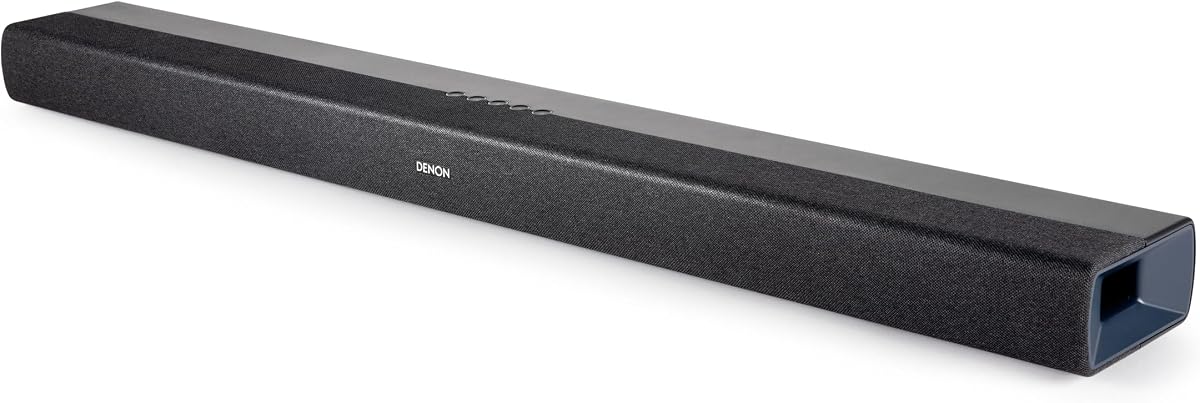
Denon DHT-S218
4.5Editor score
Dual down-firing subwoofers
Dolby Atmos home theater audio
Four tailored listening modes
Multi-point Bluetooth connectivity
Discover the 10 best soundbar with built in subwoofer options, comparing bass, channels, connectivity, dialogue, design, and room fit for modern homes today.
A soundbar with built in subwoofer can give movies, television, music, and games a fuller upgrade without requiring several separate components. The best models balance low-frequency impact, clear dialogue, useful sound effects, straightforward TV connections, and a footprint suited to everyday rooms.
This guide compares ten highly rated options using their published specifications and feature details, focusing on channel layout, bass architecture, surround-sound processing, connectivity, room adaptation, voice support, and physical design. The list includes true all-in-one systems and soundbar packages that bundle a wireless subwoofer.
Each review identifies the strongest reason to consider the model, along with practical limitations. The top selections represent an all-around premium choice, a feature-rich premium alternative, and a straightforward value option, while current prices and availability can change at any time.
4.5Editor score

4.4Editor score

4.0Editor score
The table below compares the featured soundbars by channel design, bass system, surround processing, and primary connectivity, making it easier to identify the model that best fits your television, room, and listening priorities.


The Yamaha SR-B30A combines a 2.1-channel design with two built-in subwoofers, giving it a balanced identity as a compact home-theater system. Its 4.4 rating reflects a well-rounded feature set, with Dolby Atmos, Yamaha True Sound, Clear Voice, and Bluetooth multipoint addressing sound quality, dialogue, and everyday convenience. It is a particularly attractive option for buyers who want the subwoofer function without adding a separate floor-standing box.
We may earn a commission when you buy through this link, at no additional cost to you.
The integrated subwoofers are the model's central advantage. They provide the low-frequency foundation needed for action scenes, music, and gaming, while Yamaha True Sound works with the Dolby Atmos presentation to create a wider three-dimensional sound field. Clear Voice is equally useful in real-world rooms because it can lift dialogue that might otherwise be obscured by music or effects. The included Movie, Stereo, Standard, and Game profiles make it easier to tune the presentation without navigating many complicated settings.
Its high-resolution HDMI eARC or ARC connection is another strength, supporting direct TV audio while avoiding the need for a separate complex source device. Bluetooth multipoint allows convenient switching between two devices for music and streaming. The trade-off is that the SR-B30A focuses on core soundbar performance rather than the broad smart-home integration found in more elaborate models. It also cannot create genuine overhead channel reproduction without compatible content and a suitably configured playback experience.
This is the strongest general recommendation for anyone prioritizing natural balance, impactful integrated bass, and easy operation. It works especially well in apartments, bedrooms, and medium living rooms where shelf space is limited but TV audio still feels thin. Choose the Yamaha SR-B30A when you want a single elegant enclosure, restrained styling, and a strong mix of Atmos processing and dialogue clarity rather than a collection of separate speakers.
Two built-in subwoofers give the SR-B30A more low-frequency authority than a basic 2.0 soundbar while preserving the simplicity of a single enclosure. This makes it a practical middle ground for rooms where a separate subwoofer would be inconvenient.
Clear Voice is designed to make speech easier to understand against music and effects. It is especially useful for news, scripted television, and films when the original mix places dialogue amid a busy soundtrack.
We may earn a commission when you buy through this link, at no additional cost to you.
The Denon DHT-S218 earns the highest rating among these selections at 4.5 and offers a notably complete approach to compact home cinema. It combines two built-in down-firing subwoofers with midrange drivers and tweeters in a 2.1-channel soundbar. Dolby Atmos processing adds a 3D presentation, while the Denon Dialog Enhancer and four sound modes provide practical controls for movies, music, nighttime viewing, and purer listening.
We may earn a commission when you buy through this link, at no additional cost to you.
Its down-firing subwoofers are designed to add deep, dimensional bass without a separate subwoofer enclosure. That architecture suits consumers who want a coherent home-theater system but do not want a visible subwoofer in the room. The combination of dual midrange drivers and tweeters gives the soundbar a broader tonal foundation, and the available Pure mode removes surround processing and other adjustments when listeners want a more direct presentation for music.
Connectivity is a meaningful strength. Bluetooth LE Audio is included for wireless streaming from compatible mobile devices, multi-point supports switching among several sources, and the supplied HDMI cable supports 4K HDMI eARC for compatible television connections. The trade-off is that the DHT-S218's most dramatic effects depend on the selected mode and content. It is a processing-focused soundbar rather than one with a visible array of upward-firing height drivers, so buyers should not expect every Atmos soundtrack to produce identical overhead effects.
The DHT-S218 is a persuasive premium choice for viewers who want deep bass, polished dialogue handling, and multiple listening styles in one package. It is particularly suitable for film enthusiasts, sports viewers, and households that alternate between cinematic television and music. Those who prioritize the most elaborate smart features may prefer a more connected model, but the Denon focuses its strengths on sound, which is exactly what a premium soundbar should deliver.
Pure, Movie, Music, and Night modes simplify the decision between direct playback and processed home-theater sound. Night mode can be useful when deeper effects and louder dynamics are less appropriate for a shared household.
The two down-firing subwoofers are the defining hardware feature. They allow the system to deliver more substantial bass than a slim 2.0 model while remaining visually simpler than a conventional soundbar-and-subwoofer combination.
We may earn a commission when you buy through this link, at no additional cost to you.
The Samsung HW-B400F is a compact 2.0-channel soundbar built around an integrated woofer, offering a simple way to improve television sound without adding a separate subwoofer. Its 4.0 rating reflects an approachable design aimed at essential functions: fuller bass, clearer speech, wider sound expansion, and uncomplicated control. The result is especially relevant for smaller rooms, secondary televisions, and anyone who prioritizes convenience over extensive smart features.
We may earn a commission when you buy through this link, at no additional cost to you.
The built-in woofer gives the B400F more weight at the low end than a basic dialogue-only TV speaker. Samsung's Surround Sound Expansion projects clear audio in different directions to make the listening area feel more encompassing, while Voice Enhance Mode automatically raises dialogue so speech is easier to follow. These processing features are particularly valuable because they can improve familiar content without requiring extensive technical knowledge.
Its integration with a Samsung television remote is one of the most practical details. Key functions, including power, volume, and sound effects, can be controlled without juggling multiple remotes, and the soundbar connects to the television without the cable clutter associated with more complex systems. The limitation is that its 2.0 architecture and single built-in woofer cannot match the deeper bass or wider channel presentation of the Yamaha, Denon, and Samsung S60D models in this guide.
For a buyer who wants a straightforward upgrade in a modest space, the HW-B400F is an easy recommendation. It suits daytime television, casual movies, gaming, and shared rooms where automatic dialogue enhancement and reduced nighttime output add practical value. It is less suited to enthusiasts seeking deep cinematic bass or advanced room calibration, but within that simpler brief it covers the essentials with a clean footprint.
The B400F focuses on the features that improve everyday viewing: fuller bass, dialogue emphasis, and a wider presentation. That makes it a sensible starting point when a TV's built-in speakers sound thin but a full surround system would be excessive.
The model can lower volume and minimize bass, which helps reduce disturbance in a household. This is a thoughtful feature for shared rooms where full-bodied effects would be disruptive after normal viewing hours.
We may earn a commission when you buy through this link, at no additional cost to you.
The Bose TV Speaker is an all-in-one compact model intended primarily to clarify speech and improve the spatial character of television sound. Its 4.3 rating reflects a straightforward design with two angled full-range drivers, a dialogue mode, a bass-boost mode, and support for Bluetooth, HDMI, optical, and AUX sources. While it does not include a built-in subwoofer, it remains relevant because it can later be paired with a compatible Bose Bass Module.
We may earn a commission when you buy through this link, at no additional cost to you.
The angled drivers are intended to create a wider and more natural soundstage from a small cabinet. Bose's emphasis on vocal clarity makes this particularly appropriate for news, talk shows, cooking programs, and any television where dialogue is the main content. Its included remote can add bass when desired, while the compact dimensions make placement in front of a television or wall mounting straightforward.
The primary limitation is that the bass module and required connection cable are sold separately. Buyers who want a complete, powerful low-frequency solution from the outset will need to purchase those additions. The model also depends on optical, HDMI, or AUX for the main TV connection, and its overall channel presentation is less advanced than the virtual or 3D systems offered by several competing models in this roundup.
The Bose TV Speaker is best for buyers who prioritize compact dimensions, natural TV presentation, and dialogue intelligibility over having a subwoofer immediately in the box. It is also a sensible platform for a staged setup because compatible bass modules can be added later. Choose it when a small profile and speech-focused tuning matter more than having the deepest integrated bass.
At just over two inches tall, the speaker can fit beneath many television screens without visually dominating the furniture. Its angled drivers and wall-mount compatibility make it adaptable to compact media areas.
Although no subwoofer is included, the system is compatible with Bose Bass Module 500 and 700 units. This gives buyers a way to add deeper low frequencies later without replacing the soundbar itself.
We may earn a commission when you buy through this link, at no additional cost to you.
The TCL S55H is a 2.1-channel package that pairs a soundbar with a wireless subwoofer, delivering the deep, room-filling bass associated with a conventional home-theater setup. Its 4.4 rating reflects a strong combination of Dolby Atmos, DTS:X, AI Sonic room calibration, flexible connections, and an included remote. It is an excellent choice for buyers who want more bass than an all-in-one enclosure can offer.
We may earn a commission when you buy through this link, at no additional cost to you.
The included wireless subwoofer handles low frequencies while the main bar provides crisp dialogue and detailed mids. Dolby Atmos and DTS Virtual:X expand the presentation, and AI Sonic analyzes the room and listening position to help balance the output. This is particularly valuable in apartments or smaller rooms where furniture, walls, and room proportions can change how a soundbar's audio is perceived.
The trade-off is that this is not a true built-in-subwoofer design. The subwoofer must be positioned separately, although the wireless connection removes the need to run a long cable back to the main unit. The package is also physically larger than a single soundbar, and its room-calibration setup adds a step that some buyers may not need. Its maximum power figure should not be treated as a direct indicator of every aspect of audio quality.
The S55H is recommended for home viewers who want genuinely deep bass, automatic optimization, and flexible source selection. It works well for movies, music, games, and projectors, while HDMI eARC, optical, Bluetooth, and AUX connections make it adaptable to different equipment. Choose it over a compact all-in-one model when dedicated subwoofer placement and a fuller low-frequency presentation are worth the additional footprint.
AI Sonic automatically adjusts the system through the TCL app using a one-time setup process. This can help produce more consistent results in rooms with reflective surfaces, furniture, and irregular speaker placement.
The package includes an HDMI cable, power cord, remote with batteries, and wall-mount kit. The separate subwoofer can be positioned around a seating area for a more effective low-frequency result.
We may earn a commission when you buy through this link, at no additional cost to you.
The Yamaha SR-B20A delivers the core qualities sought in a soundbar with built-in subwoofers: a slim all-in-one enclosure, deep bass, clear speech, and virtual surround processing. Its 4.4 rating places it among the strongest-rated models in the group. Dolby Audio, DTS Virtual:X, and Yamaha Clear Voice give it a capable feature set without requiring separate speakers.
We may earn a commission when you buy through this link, at no additional cost to you.
Built-in subwoofers provide the foundation for impactful movie effects and music while keeping the physical setup uncluttered. DTS Virtual:X creates a sense of sound moving around the listener, and Clear Voice is designed to preserve dialogue that might be masked by effects or background music. Bluetooth supports easy music streaming and switching between two connected devices, which makes the bar useful beyond television use.
Setup is straightforward through HDMI or optical connections, and a remote control is included. The main limitation is that the feature set lacks some of the more recent refinements found elsewhere, including automatic room calibration, sophisticated app-based adjustment, and extensive voice-assistant integration. DTS Virtual:X also creates a virtual presentation rather than reproducing the same effect through a physical set of height or rear speakers.
The SR-B20A is a compelling choice for buyers who value Yamaha's established soundbar engineering and want a straightforward one-piece solution. It fits well in living rooms and secondary media spaces where bass and dialogue matter more than smart-home features. Those who need deeper sub-bass should consider the separate-subwoofer TCL system, while those wanting a more advanced Atmos experience can move up to the Yamaha SR-B30A.
The integrated design preserves the uncluttered appearance of a normal soundbar while providing more low-frequency support. It is a good fit when a separate subwoofer would be difficult to place or visually undesirable.
DTS Virtual:X expands the apparent sound field without requiring rear channels. The result cannot equal a carefully arranged multi-speaker system, but it can add depth and direction to compatible television and streaming content.
We may earn a commission when you buy through this link, at no additional cost to you.
The Hisense A620 is a 2.1-channel all-in-one soundbar distinguished by a visible built-in subwoofer beneath a transparent acrylic cover. Its 4.3 rating reflects a capable mix of 240 watts of stated power, Dolby Digital Plus, DTS Virtual:X, Bluetooth 5.3, and several wired connections. It also supports Roku TV Ready operation and integrates with Hisense televisions, making it a particularly relevant option for compatible setups.
We may earn a commission when you buy through this link, at no additional cost to you.
The exposed 75-by-160-millimeter woofer gives the product a visual identity that most soundbars do not have. Rather than hiding the bass driver inside a conventional cabinet, Hisense makes its movement visible and adds low-frequency output to the 2.1-channel design. Dolby Digital Plus and DTS Virtual:X provide surround-oriented processing, while TV mode can use a compatible television's decoding capability for Dolby Atmos content that the soundbar cannot decode directly.
EzPlay allows a compatible television remote to control the soundbar and can present its settings within the television menu. HDMI ARC, AUX, USB, and Bluetooth cover a useful range of sources, and the system is designed to blend with Hisense televisions. The trade-off is that a soundbar in this entry-level class does not natively support Dolby Atmos, and the visible woofer may not suit every entertainment setup.
The Hisense A620 is a distinctive choice for buyers who want integrated bass and a more industrial-looking design. It is a strong match for compatible Hisense or Roku TV ecosystems and for users who want multiple input options without a separate subwoofer. Choose it when its transparent woofer design appeals to you and TV-mode Atmos playback is an acceptable alternative to native decoding.
The transparent cover makes the subwoofer's vibration part of the visual experience. It provides a talking point that conventional enclosed soundbars cannot replicate and can appeal to listeners who enjoy technical design details.
EzPlay integrates control and settings with compatible televisions. This can reduce the inconvenience of switching inputs or hunting for a separate remote whenever basic soundbar adjustments are needed.
We may earn a commission when you buy through this link, at no additional cost to you.
The Samsung HW-S60D is the most feature-dense all-in-one model in this group, combining a 5.0-channel architecture, built-in subwoofers, up-firing speakers, wireless Dolby Atmos, Q-Symphony, SpaceFit Sound Pro, Adaptive Sound, and Game Mode Pro. Its 4.4 rating reflects a broad set of capabilities in a single cabinet. It is especially compelling for Samsung television owners who can exploit the ecosystem-specific features.
We may earn a commission when you buy through this link, at no additional cost to you.
Five physical channels and integrated subwoofers provide a broader foundation than a basic 2.0 or 2.1 soundbar. Up-firing speakers help create elevated effects, while Adaptive Sound analyzes scenes to emphasize important elements and Active Voice Analyzer prioritizes onscreen voices. SpaceFit Sound Pro analyzes the room and adjusts the output, making the system more attentive to real-world placement than simpler models.
Q-Symphony allows a compatible Samsung television and soundbar to work together as a unified audio system. The model also supports Wireless Dolby Atmos, reducing the need for a cable between compatible components, and includes built-in Alexa alongside Chromecast and AirPlay 2 support. The trade-off is ecosystem dependence: the most distinctive functions are designed around compatible Samsung equipment, and advanced automatic processing may not suit every source or room.
The HW-S60D is recommended for users who want the largest all-in-one feature set and own compatible smart-home or Samsung TV equipment. It is particularly well suited to gaming, sports, and films, with dedicated modes for those activities. Buyers seeking a more neutral or minimal system may prefer the Yamaha, while those who want the strongest Samsung integration will find this model difficult to overlook.
SpaceFit Sound Pro evaluates the environment and adjusts the sound for the room. This is useful when a soundbar is placed in an acoustically difficult position or must serve an irregularly shaped seating area.
Q-Symphony coordinates the soundbar with compatible Samsung televisions, while Wireless Dolby Atmos offers a cleaner connection arrangement. The benefit is strongest when the television and soundbar are from the same supported ecosystem.
We may earn a commission when you buy through this link, at no additional cost to you.
The Samsung HW-B550F combines a 2.1-channel soundbar with an included wireless subwoofer, offering a flexible alternative to models with fully integrated bass drivers. Its 4.3 rating reflects strong support for deep sound, DTS Virtual:X spatial audio, Adaptive Sound, Voice Enhance Mode, and Bass Boost. It is also the only option here that clearly supports later expansion with optional wireless rear speakers.
We may earn a commission when you buy through this link, at no additional cost to you.
The subwoofer supplies the deep, rich low end described in the product features, while the main bar handles dialogue and midrange detail. Multi-directional spatial audio helps the presentation extend around the listener, and Adaptive Sound identifies the type of content on screen to adjust the mix. Voice Enhance Mode raises dialogue, while Bass Boost provides a more forceful effect for action sequences and rhythmic music.
Its flexibility also creates a trade-off. The subwoofer is a separate object, even though it connects wirelessly, and optional rear speakers are additional equipment rather than included components. The system therefore offers more expansion potential than a permanently integrated model but takes more space and offers less immediate simplicity. Users should also verify the required source, television, and app compatibility before relying on advanced features.
The HW-B550F is a strong recommendation for Samsung users who want substantial bass and may later create a more complete surround setup. It is well suited to gaming, action movies, and everyday television in medium-sized rooms. Choose it when dedicated subwoofer placement and future rear-channel expansion are priorities; choose a one-enclosure model such as the HW-B400F when simplicity matters more.
A wireless connection removes the long cable normally required between a soundbar and subwoofer. That makes it easier to place the bass enclosure near a corner or another location that better suits the listening area.
Optional wireless rear speakers can expand the system beyond virtual processing. The upgrade allows a more conventionally directional surround presentation, provided the room and placement can support rear channels properly.
We may earn a commission when you buy through this link, at no additional cost to you.
The Samsung HW-C400 is a straightforward 2.0-channel soundbar with two built-in woofers and a sound duct designed to strengthen bass through air vibration. Its 4.0 rating makes it a basic but practical option for improving television audio, particularly in smaller rooms. Dolby Audio, DTS, Bluetooth, NFC, and USB playback make it more versatile than a basic TV speaker.
We may earn a commission when you buy through this link, at no additional cost to you.
The internal woofer arrangement gives the C400 more low-frequency presence than a slim bar with miniature drivers alone. Its sound duct intensifies the bass output, while Dolby Audio and DTS processing create a fuller surround impression from the two-channel enclosure. Bluetooth supports convenient music streaming, NFC offers a simple phone-to-soundbar connection method, and the integrated USB port allows direct playback from a compatible memory device.
As the most straightforward model in the group, the C400 does not offer automatic room calibration, a sophisticated app ecosystem, a dedicated wireless subwoofer, or the same degree of upward-firing spatial audio. Its 2.0 layout also cannot provide discrete surround channels. The 110-to-240-volt power specification is unusual for a modern soundbar and supports use across a broad range of compatible voltage environments.
The HW-C400 makes sense for straightforward television, music, and small-room use where a single compact unit is preferred. It is a practical alternative for anyone who dislikes visible subwoofer boxes but still wants stronger low frequencies than a television can provide. Buyers seeking modern Atmos processing, deep dedicated bass, or room-aware tuning should look to the Yamaha, Denon, or newer Samsung options instead.
The internal duct works with the two built-in woofers to intensify low-frequency output. This design helps the C400 deliver more impact while preserving a conventional, relatively compact soundbar appearance.
Bluetooth, NFC, and USB playback make the C400 useful for music as well as television. These options can be particularly useful in a kitchen, bedroom, or secondary media area where wireless convenience is more important than advanced home-theater processing.
We may earn a commission when you buy through this link, at no additional cost to you.
The right choice depends on room size, television ecosystem, content habits, and how much equipment you are willing to place around the room. Compare the physical bass architecture, processing features, connections, and control options before choosing.
A genuinely integrated subwoofer keeps the system to one main enclosure, simplifies placement, and reduces visible equipment around the television. It is especially useful in apartments, bedrooms, and minimalist living rooms. However, a separate wireless subwoofer can usually be positioned more freely and may deliver deeper low-frequency output. Buyers should also note that some products described as soundbar-and-subwoofer packages do not have the bass drivers physically built into the bar.
A 2.0-channel system prioritizes a compact footprint, while 2.1-channel systems add a dedicated low-frequency channel. Models with five channels, up-firing speakers, and virtual surround processing can produce a broader soundstage from a single cabinet. Dolby Atmos and DTS Virtual:X are processing technologies rather than physical speaker counts, so their perceived impact depends on source material, television processing, room acoustics, and the manufacturer's tuning.
Many modern soundbars include a dialogue-enhancement function that raises speech relative to music and effects. Yamaha calls its system Clear Voice, Denon uses Dialog Enhancer, and Samsung provides Voice Enhance Mode and Active Voice Analyzer. These tools are particularly useful for news, sports commentary, and films with complex sound mixes. They are also valuable for people who listen at lower volumes, although the most natural setting will vary by program and room.
HDMI eARC is the preferred connection when both the television and soundbar support it because it can carry advanced audio signals, accommodate control functions, and reduce the need for multiple cables. ARC remains useful for compatible sets, while optical, AUX, USB, and Bluetooth provide additional flexibility. Pay attention to included cables, the number of available inputs, and whether the system supports wireless Dolby Atmos or convenient control through the television remote.
The stated power or wattage figure alone does not determine how a soundbar will sound in your room. A large space benefits from a subwoofer that can move air effectively, while a compact room may be overwhelmed by excessive low-frequency output. Integrated systems are easy to place centrally, whereas separate subwoofers need an available outlet, floor space, and a location that supports stronger bass response. Wall-mounting options, cabinet depth, and grille design are also practical considerations.
Some soundbars integrate voice assistants, casting platforms, smartphone apps, automatic room calibration, and television-specific synchronization. These features can improve convenience, but they are most valuable when they work with equipment already in your home. Q-Symphony is designed for compatible Samsung televisions, while voice assistants, wireless streaming platforms, and app-based calibration vary by model. Owners of a mixed television ecosystem may receive a better experience from a more universal system.
Film sound benefits from dialogue enhancement, virtual surround, and forceful bass, but music can sound more natural with direct processing. The Yamaha SR-B30A includes Stereo and Standard profiles, while the Denon DHT-S218 has a dedicated Pure mode. Bluetooth multipoint is useful for switching between television and mobile music. If music is a primary use, test the soundbar with familiar recordings and compare the most neutral available mode.
Some all-in-one systems can add a compatible bass module, while others support wireless rear speakers for a more traditional surround layout. Expansion is useful when a room is not ready for a full system on day one, but accessories add to the final cost and setup complexity. Check whether rear speakers are sold separately, which connection method they use, and whether additional hardware changes the warranty or supported feature set.
Begin by identifying the soundbar's intended primary role and placing the main unit near the television, preferably centered at the same height as the screen. For a separate wireless subwoofer, begin near the front corner of the room and move it later based on the strongest, cleanest bass response. Keep ventilation openings clear and avoid placing the system inside a closed cabinet unless its manufacturer explicitly permits that arrangement.
Connect the soundbar to the television using the best mutually supported digital connection, normally HDMI eARC. Complete any television audio-output and soundbar control settings before starting content, then select a suitable mode such as Movie, Standard, Game, Stereo, or Pure. Run an available room-calibration or setup routine in the final listening position, and make modest adjustments rather than repeatedly changing several processing features at once.
For everyday care, remove dust gently from the grille with a soft, dry cloth and keep liquids away from the cabinet and connections. Do not push objects into the woofer opening or visible driver area, and avoid aggressive cleaners that could damage the finish. Update associated television and smartphone apps when needed, check wireless connections after moving the equipment, and keep the original cables and documentation for future setup changes.
A built-in subwoofer is housed inside the soundbar, keeping the system to one main enclosure and simplifying placement. A wireless subwoofer is a separate speaker that communicates with the bar without a long connecting cable. It usually offers more placement flexibility and potentially deeper bass, but it requires additional floor or shelf space.
The better option depends on the room and priorities. An integrated model is tidier and easier to install, while a separate subwoofer can be placed for stronger results and provide a larger sense of low-frequency impact. Consider cabinet space, outlet access, listening distance, and whether the system must remain visually minimal.
They can, because the integrated design avoids a separate box and usually suits smaller furniture layouts. Bass levels should still be adjusted carefully, since a compact room can amplify low frequencies and make a system sound boomy. Dialogue and night modes can help reduce harshness or disturbance during quieter viewing.
No. Dolby Atmos can create a more immersive presentation with compatible content, but clear dialogue, balanced tonal character, useful bass, and room-appropriate tuning are more important for everyday satisfaction. Some soundbars also use their television's decoding capability to provide Dolby Atmos through HDMI ARC or eARC.
Center the bar near the television and make sure its grille is not blocked. Keep the unit away from enclosed spaces that trap heat, and use the manufacturer's wall-mounting guidance if applicable. For a separate wireless subwoofer, start near a front corner and reposition it while listening for stronger but less boomy bass.
Most models in this guide include dialogue-focused processing intended to make speech more prominent against music and effects. The exact result varies by program, room acoustics, and settings. A moderate adjustment is usually more natural than using maximum dialogue enhancement for every type of content.
HDMI eARC is generally the most capable and convenient connection when both devices support it, particularly for compatible surround formats, high-bandwidth audio, and integrated control. ARC can also work well, while optical and AUX are useful for older televisions or additional sources. Bluetooth is intended mainly for convenient music and mobile-device playback.
Only if those features will improve your regular setup. Voice assistants, casting, smartphone control, and television synchronization are valuable when integrated with equipment you already own. If your television and other devices use different ecosystems, a straightforward HDMI soundbar with strong bass and dialogue handling may deliver more practical value.
The Yamaha SR-B30A is the most balanced overall recommendation because it combines two integrated subwoofers, Dolby Atmos, Clear Voice, high-resolution HDMI support, and useful listening profiles in a clean enclosure. The Denon DHT-S218 is a premium alternative for buyers who prioritize deeper bass, multiple tailored modes, and flexible music playback, while the Samsung HW-B400F serves buyers who want a simple and compact upgrade without a separate subwoofer.
Before choosing, prioritize the features you will actually use. Integrated-bass buyers should consider driver count, dialogue tools, TV connectivity, and room size; those wanting deeper low frequencies may be better served by the TCL S55H or Samsung HW-B550F package. It is also worth checking television compatibility, cable requirements, placement space, and whether ecosystem-specific features will benefit the equipment already in your home.
Ratings and specifications provide a useful starting point, but the best soundbar is ultimately the one that suits your room, television, content, and tolerance for cables or extra speakers. Check current prices, availability, compatibility lists, and included accessories at the time of purchase, since these details can change and may affect which model offers the strongest overall value.