
Heavy Lift Drone, 10 kg
22 lb maximum load
55 minutes unloaded
IP64 sealed structure
Our High Payload Drone guide compares ten aerial platforms for carrying cargo, including payload limits, flight endurance, cameras, controls, safety systems
A high payload drone is built to do more than capture scenic footage: it can carry compact supplies, fishing bait, emergency items, camera equipment, or other mission-specific cargo. The strongest choices combine usable carrying capacity with stable flight, dependable positioning, obstacle awareness, manageable controls, and enough endurance to complete an operation without an excessive number of battery changes.
This guide compares ten real products across payload capability, camera performance, flight time, transmission range, navigation features, deployment design, and control options. It includes compact payload drones, heavy-lift cargo platforms, camera-focused models, and upper-tier creator aircraft so buyers can distinguish between carrying capacity, imaging capability, operational flexibility, and value.
Each selection highlights the features that make a particular drone suitable for a different type of buyer, from lightweight airdrops to industrial cargo work. Ratings reflect the available customer feedback, while specifications and feature claims come from the supplied product information. Product availability and prices can change, so confirm the current listing and local requirements before purchasing.

4.8Editor score

4.4Editor score
The comparison below organizes all ten drones by their most important characteristics, including usable cargo capacity, imaging equipment, endurance, control experience, and safety features. It reveals that the term high payload covers very different needs, from sub-kilogram airdrop systems to industrial platforms designed for loads approaching 22 pounds.




The FPV Drone with 2.7K Camera for Adults stands out as the most balanced high payload option in this guide. Its 4.8 rating reflects strong customer feedback, while its 0.66-pound payload limit is meaningful without placing it in the same class as the industrial cargo aircraft. The aircraft combines a stabilized dual-camera system, touchscreen remote, airdrop mechanism, obstacle avoidance, dual positioning, and two batteries in one relatively portable package.
We may earn a commission when you buy through this link, at no additional cost to you.
Its most attractive feature is the built-in one-key payload release. That makes the drone useful for fishing, camping, outdoor events, and creative shoots where carrying a small object to a target location matters as much as recording the trip. A 3-axis gimbal smooths the 2.7K footage, while the 4.92-inch touchscreen gives pilots direct access to live imagery and camera adjustments without relying on a conventional phone screen.
Safety and convenience are particularly strong for a payload-capable model. Four-way intelligent obstacle avoidance works alongside GPS and optical-flow positioning, while one-key, low-battery, and signal-loss return modes provide several ways to recover the aircraft. The total flight time of up to 50 minutes is divided across two high-capacity batteries, and the included case, memory card, reader, cables, propellers, screwdriver, and manuals make the package unusually complete.
The limitation is obvious: this is not a substitute for a 22-pound heavy-lift platform. Its 5G FPV system may also be less predictable in congested RF environments than a dedicated long-range control link. Even so, it offers the best intersection of payload capability, imaging, safety systems, portability, and included equipment in the list, making it the strongest general recommendation for buyers whose cargo needs remain modest.
The 0.66-pound limit is large enough for many lightweight missions, and the integrated release mechanism removes the need to improvise a custom drop system. That combination makes the aircraft more useful than a standard camera drone while remaining much easier to transport than a large industrial airframe.
Four-way obstacle avoidance, dual positioning, and automatic return behavior create a reassuring feature set for new and experienced pilots. These systems do not eliminate the need for careful planning, but they add useful layers of protection around navigation, low-battery recovery, and signal interruptions.
We may earn a commission when you buy through this link, at no additional cost to you.
The Heavy Lift Drone, 10 kg is the clear specialist choice for buyers who need to move substantial cargo. Its listed maximum load is 22 pounds, while its 200-pound maximum takeoff weight indicates a much larger airframe than the consumer aircraft in this roundup. It is designed for heavy-duty cargo delivery and industrial work rather than casual scenic photography.
We may earn a commission when you buy through this link, at no additional cost to you.
The platform uses an aluminum-alloy crossbeam, carbon-fiber propellers, and a combination of PE, PP, PA+GF, and aluminum alloy in its construction. An IP64 sealed structure helps protect internal circuits from dust and water, making the design more appropriate for demanding environments than a purely recreational folding drone. The package also supports two-battery and dual-plug configurations for different operational requirements.
Deployment is a major strength. A horizontal folding design with locking arms allows tool-free assembly and reduces the storage footprint, while a pre-installed gimbal mount and four-stage deployment system provide flexibility for different payload arrangements. Endurance is also clearly differentiated: the aircraft is listed for up to 55 minutes without a load and 30 minutes with a full load.
This is the top premium selection for a reason, but it is not the easiest recommendation for every buyer. Its size, specialized construction, and no available customer rating mean careful planning is essential. Operators should also verify payload distribution, field conditions, local rules, and the exact configuration included in the listing. For genuine industrial-scale carrying needs, however, none of the other models comes close.
A 22-pound maximum load opens doors that a sub-kilogram airdrop drone cannot address. It could support larger components or supplies where payload mass, gimbal integration, and structural strength matter more than pocket-sized portability or recreational controls.
Folding arms with locks reduce setup time and storage requirements, while the four-stage deployment system and installed gimbal mount broaden mission-planning options. The design appears aimed at teams that need to move from transport to operation with as little manual assembly as possible.
We may earn a commission when you buy through this link, at no additional cost to you.
The AE30 Ultra Drone combines a 500-gram one-click airdrop mechanism with a 4K UHD camera, a three-axis mechanical gimbal, and electronic image stabilization. Its 4.4 rating indicates generally favorable customer feedback, and the broad feature set makes it a practical entry point for buyers who need to carry small items without moving into a dedicated industrial platform.
We may earn a commission when you buy through this link, at no additional cost to you.
The payload mechanism is presented for gifts, rescue supplies, wedding props, and other small deliveries. Although 500 grams is modest compared with the 0.66-pound and 22-pound alternatives here, it is enough to cover many lightweight tasks. The included 7.2-inch touchscreen controller removes phone dependence and supports live viewing, material editing, Wi-Fi access, video playback, and one-click sharing.
Safety features are unusually thorough for this class. Retractable, liftable obstacle-avoidance modules provide 360-degree real-time scanning, while GPS and optical flow support automatic returns triggered by a user command, signal loss, low battery, or going out of range. Three batteries are included, and each is described as supporting up to 45 minutes of flight with a three-hour fast-charging cycle.
The foldable body and custom backpack help offset the large screen, although this model remains less discreet than a small camera drone. It is best for buyers who value a proper cargo release, abundant batteries, and a large control interface over maximum payload or compactness. Overall, it delivers the most approachable blend of delivery and imaging features without requiring a heavy-lift system.
The one-click release provides a clear, understandable way to deliver small items, while the large touchscreen keeps flight status and live imagery in one place. That makes the aircraft approachable for missions involving gifts, small supplies, or creative event drops.
Three batteries provide a substantial total endurance figure, reducing battery-swap interruptions during a full session. Expandable all-direction obstacle sensors add useful protection, especially when the pilot must concentrate on reaching a drop point rather than solely on recording footage.
We may earn a commission when you buy through this link, at no additional cost to you.
The DJI Air 3S Fly More Combo is a refined imaging and travel platform with a 4.7 rating, though the supplied information does not identify a cargo rating. Its 1-inch CMOS primary camera, 4K/60fps HDR recording, and free panorama modes make it more compelling for visual projects than for carrying substantial equipment.
We may earn a commission when you buy through this link, at no additional cost to you.
The imaging system is designed to retain detail in low-light scenes such as sunsets and night landscapes. HDR video can preserve cloud textures and richer tonal transitions, while the panorama modes include wide-angle and medium-telephoto options. Forward-facing LiDAR and additional sensors support nightscape omnidirectional obstacle sensing, helping the aircraft navigate around buildings more effectively during darker flights.
Operational features include a maximum flight time of 45 minutes, 20 kilometers of video transmission, and an upgraded Return-to-Home algorithm that can select a suitable route even in weak GPS conditions. The Fly More Combo includes three intelligent flight batteries, a charging hub, an ND filter set, and the DJI RC 2 controller with a built-in screen.
Buyers should note that the supplied product information does not specify a payload capacity, and the battery charger is sold separately. It therefore belongs in this guide as a high-end aerial platform rather than a confirmed cargo carrier. It is ideal for buyers who want excellent imaging and navigation but do not need a dedicated airdrop or heavy-lift mechanism.
The 1-inch primary sensor and 4K/60fps HDR format give this aircraft a clear advantage for sunset, travel, and nightscape work. Users can also choose panoramic compositions without relying on third-party stitching workflows.
LiDAR-assisted sensing and intelligent Return-to-Home support are valuable when flying near buildings or in areas where a simple return route may be difficult. The screen-equipped RC 2 controller also reduces the need to manage a separate mobile device during flight.
We may earn a commission when you buy through this link, at no additional cost to you.
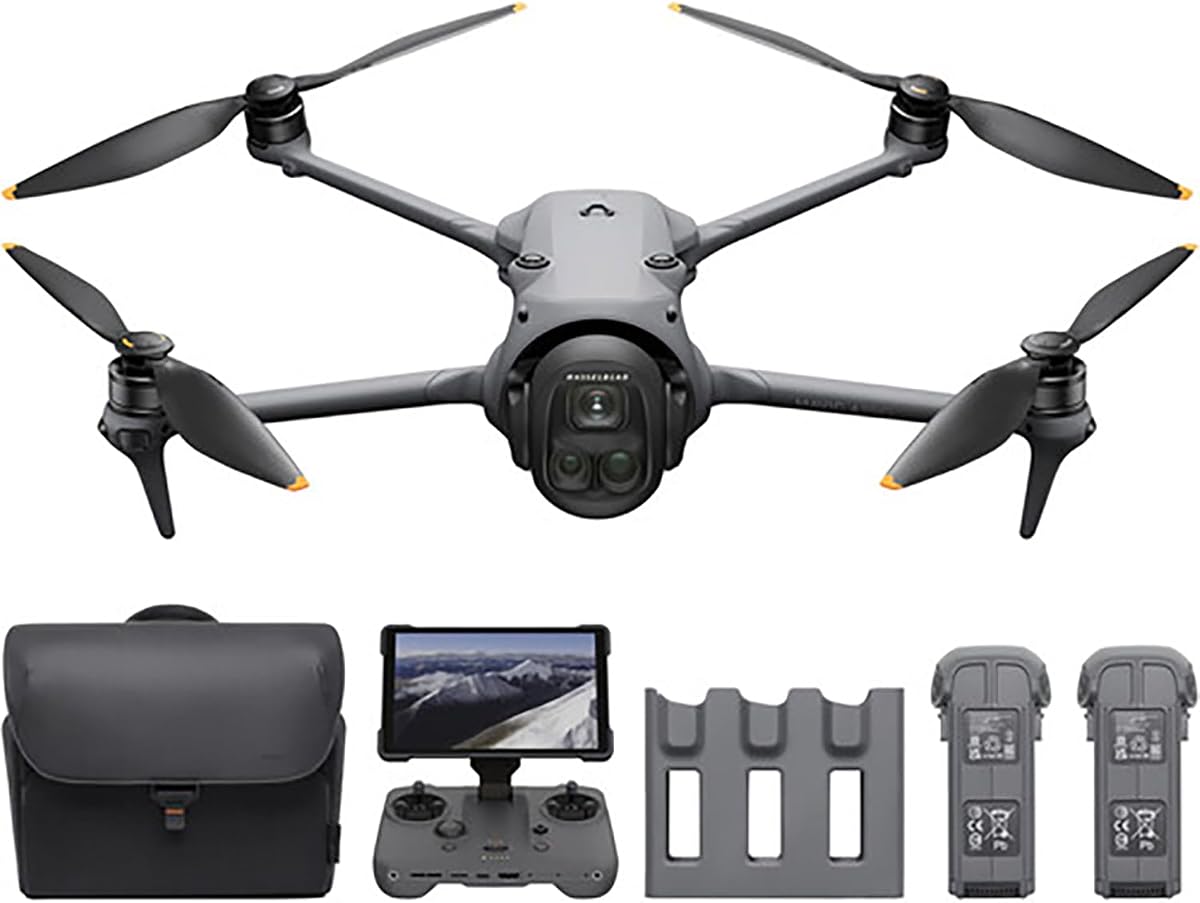
The DJI Mavic 4 Pro Fly More Combo is built for demanding aerial imaging, with a 4.4 rating and a comprehensive professional camera system. Its 4/3-inch CMOS Hasselblad camera supports 100-megapixel photos and 6K/60fps HDR video, while the 100MP Hasselblad output is intended to preserve considerable detail in demanding creative work.
We may earn a commission when you buy through this link, at no additional cost to you.
The triple-camera arrangement adds flexibility. A 1/1.3-inch 48MP medium telephoto and 1/1.5-inch 50MP telephoto lens can isolate distant subjects and provide compressed perspectives, while the main Hasselblad camera handles general high-resolution capture. The Infinity Gimbal offers 360-degree rotation for Dutch angles and unconventional orientations, and the 0.1-lux nightscape vision combines LiDAR with omnidirectional obstacle sensing.
Long-range and creative features are equally substantial. A high-capacity 95Wh battery supports up to 51 minutes of flight, while O4+ provides a 30-kilometer 10-bit HDR live feed. ActiveTrack 360 keeps subjects framed in challenging lighting, 4K/120fps recording captures smooth slow motion, and onboard storage reaches 512GB in the creator configuration described in the product information.
No payload rating is stated, so the Mavic 4 Pro should not be treated as a dedicated cargo aircraft based on this guide. It is more appropriate for buyers who interpret payload as a flexible creative platform capable of professional sensors, tracking, transmission, and media workflows. Those priorities come with added complexity, so pilots should invest time in mastering its controls and automated modes.
The combination of a large main sensor and two telephoto cameras allows a single aircraft to cover wide landscapes, compressed distant views, and subject-focused portraits. That versatility can reduce the need to change aircraft between different parts of a shoot.
O4+ transmission, 4K/120fps capture, onboard media storage, and Wi-Fi 6 QuickTransfer support a more structured production workflow. These features are less about carrying cargo and more about acquiring, reviewing, and moving high-resolution media efficiently.
We may earn a commission when you buy through this link, at no additional cost to you.
The DJI Mini 5 Pro Fly More Combo Plus is the most portable high-end option in the guide. Its foldable, palm-sized body and approximate weight of 249.9 grams make it far easier to carry than the larger DJI models, while its 1-inch CMOS sensor, 4K/60fps HDR video, and 42GB internal storage preserve a strong creative feature set.
We may earn a commission when you buy through this link, at no additional cost to you.
The 225-degree gimbal rotation and true vertical filming capability provide unusual framing flexibility. Nightscape omnidirectional obstacle sensing adds a forward-facing LiDAR and vision sensors for safer flight, while upgraded ActiveTrack 360 offers customizable modes for subjects such as cyclists. These are sophisticated imaging and navigation features in a compact airframe.
Three Intelligent Flight Battery Plus units are included, each supporting up to 52 minutes of flight. The charging hub, ND filters, spare propellers, and DJI RC 2 controller round out the package. Fast charging is stated to power three batteries in approximately 193 minutes, helping reduce downtime during a full shooting day.
The supplied information does not state a payload capacity, so the Mini 5 Pro should be treated as a compact imaging platform rather than a purpose-built cargo drone. Its nearly 250-gram weight also places it in a different regulatory category from larger aircraft in many locations. Buyers should confirm local requirements, particularly for nighttime operations, and download the DJI Fly app from the official website because it is not available through Google Play.
The Mini 5 Pro avoids a simple image-quality compromise by pairing a 1-inch sensor with 4K/60fps HDR recording and 42GB of internal storage. Its small folded footprint makes it easier to carry between locations without giving up advanced tracking and obstacle-sensing tools.
The gimbal's 225-degree roll range and true vertical mode make it easier to compose for social formats, overhead shots, and unusual perspectives. ActiveTrack 360 complements that flexibility by keeping moving subjects centered during hands-off segments.
We may earn a commission when you buy through this link, at no additional cost to you.
The DJI Mavic 4 Pro 512GB Creator Combo is the high-spec media version of the Mavic 4 Pro family. It shares the 100MP Hasselblad camera, dual telephoto cameras, 6K/60fps HDR recording, 51-minute maximum flight time, and O4+ 30-kilometer transmission with the Fly More Combo, but adds up to 512GB of onboard storage and the DJI RC Pro 2 controller.
We may earn a commission when you buy through this link, at no additional cost to you.
The 4/3-inch main sensor produces 100MP photographs, while the 48MP medium telephoto and 50MP telephoto modules support distant details and compressed perspectives. The Infinity Gimbal enables 360-degree rotation, and 0.1-lux nightscape vision adds LiDAR-assisted awareness in extremely dark conditions. ActiveTrack 360 and 4K/120fps slow-motion capture further broaden the production toolkit.
The defining advantage is workflow efficiency. Onboard UFS storage supports ALL-I 4:2:2 encoding, and QuickTransfer with Wi-Fi 6 moves 100MP RAW files and 6K video at 80MB per second without requiring the drone to be powered on. For creators producing large volumes of high-resolution media, the extra storage and faster transfer process can be more valuable than incremental camera changes.
Its listed rating of 4.0 is lower than the ratings attached to the other customer-reviewed DJI models in this list, so buyers should treat it as a product with meaningful but less uniformly positive feedback. No cargo rating is provided, making this a creative-production aircraft rather than a confirmed delivery platform. It is best for buyers who need maximum media capacity and a premium controller.
Up to 512GB of internal storage reduces the need to offload footage during a session, which is particularly useful for 6K clips and high-resolution RAW photographs. It also makes the bundle more self-contained for intensive field work.
The RC Pro 2 controller, O4+ transmission, tracking features, and near-darkness obstacle sensing create a package aimed at experienced operators. Pilots should confirm the controller and software workflow fit their production habits before buying.
We may earn a commission when you buy through this link, at no additional cost to you.
The Bingchat Tablet Remote Professional Drone combines a 5.0 rating with a broad collection of payload, imaging, navigation, and display functions. Its most relevant feature for this guide is an integrated payload release system, although the supplied listing does not state a maximum carried weight, so the exact task should be checked before operation.
We may earn a commission when you buy through this link, at no additional cost to you.
The controller is effectively a large Android tablet with Google support and access to the Play Store. It can display the live camera feed, handle flight controls, and run additional applications, giving it more flexibility than a conventional screen-only controller. A 3-axis gimbal, electronic stabilization, a 130-degree field of view, a larger CMOS sensor, and 50x digital zoom support 4K recording in day and night conditions.
The listed safety and flight features are extensive. They include 360-degree laser obstacle avoidance, GPS Follow Me and Follow Car modes, high wind resistance, rainproofing, a night-vision mode, time-lapse, low-battery alarm, automatic return, find-the-drone function, 360-degree surround shooting, waypoint flight, gesture capture, and LED detection lights. Two 11.1-volt batteries provide up to 84 minutes of combined flight under the stated no-wind conditions.
Local support is another selling point. The product information mentions low-cost replacement parts, app and tablet-system updates, one year of quality replacement coverage, and three years of flight-quality support. The model also states that it has completed certification and complies with the FAA Declaration of Compliance, though operators must still follow all applicable local rules. It is a flexible choice, but the lack of a stated payload limit deserves careful attention.
The integrated Android tablet provides a bright control and media interface while supporting additional apps and Wi-Fi connectivity. That turns the controller into a more useful field device than a basic transmitter with a small status display.
Follow modes, waypoint flight, point-like automated capture functions, time-lapse, gesture control, and surround shooting give the aircraft many ways to complete a mission. The breadth is useful for experimentation, though pilots should learn each mode in a clear area before relying on it around obstacles.
We may earn a commission when you buy through this link, at no additional cost to you.
The DJI Mavic 2 PRO Fly More Kit is an established aerial camera platform with a 4.6 rating and a recognizable feature set. Its Hasselblad L1D-20c camera uses a 20MP 1-inch CMOS sensor, delivering detailed aerial stills and color performance suited to travel, landscape, and general creative work.
We may earn a commission when you buy through this link, at no additional cost to you.
Flight specifications include up to 31 minutes of endurance, a maximum speed of 44 mph, a 907-gram takeoff weight, a three-axis gimbal, and 8GB of internal storage. The aircraft supports SD cards up to 128GB. ActiveTrack 2.0, omnidirectional obstacle sensing, Hyperlapse, a low-noise design, adjustable aperture, and HDR photography round out the feature set.
The Fly More Kit includes two extra intelligent flight batteries, a charging hub, a car charger, a battery-to-power-bank adapter, two pairs of low-noise propellers, and a shoulder bag. The product information specifically advises updating the firmware to version 01.00.00.00 or higher through the app or DJI Assistant 2 so that features such as Hyperlapse can be used.
As an older platform, its 31-minute maximum and 8GB internal storage trail the newest camera drones, and no payload capacity is provided. Nevertheless, the 4.6 rating, obstacle sensing, established camera system, and generous accessory bundle make it an appealing option for buyers who value a proven flying experience and included essentials over the newest specifications.
The 1-inch Hasselblad sensor remains capable of detailed, colorful images, while the adjustable aperture and HDR support provide useful control in changing light. The three-axis gimbal also helps maintain stable framing during flight.
Extra batteries, a hub, a car charger, a power-bank adapter, propellers, and a shoulder bag make the bundle ready for extended outings. Updating the firmware before the first flight is essential to access the described feature set reliably.
We may earn a commission when you buy through this link, at no additional cost to you.
The GPS Fishing Drone with Bait Release is a purpose-built 600-gram payload platform with a 5.0 rating. Its integrated bait-release system is intended to deliver bait over lakes, rivers, reservoirs, and offshore locations beyond the reach of conventional casting, making it one of the clearest matches for a specific payload job in this guide.
We may earn a commission when you buy through this link, at no additional cost to you.
The aircraft also serves as a capable camera platform. A 4K camera, three-axis gimbal, and electronic image stabilization are designed to reduce shake during movement and windy conditions. The included 7.2-inch HD touchscreen remote provides a live FPV view and touch controls, allowing operation without a phone and making it easier to judge bait placement from the aircraft's perspective.
Navigation and endurance support precise, extended missions. The listed 10-kilometer HD FPV transmission, Follow Me, Waypoint Flight, and Point of Interest modes help the pilot reach a target and repeat a route. Three intelligent batteries provide up to 120 minutes of total flight time, while omnidirectional obstacle avoidance and GPS Auto Return add protection during the trip.
The 600-gram limit is the key specification to verify against your actual bait and accessories, including the release mechanism and any protective packaging. This model is less versatile for general industrial lifting than the heavy-lift option, but it offers a much more focused package for fishing and remote bait placement. It is also a strong choice for buyers who want both useful imaging and a clearly stated payload capacity.
The integrated release mechanism gives anglers a way to move bait toward selected water locations without relying on a cast. GPS-assisted modes and the live touchscreen view help the pilot evaluate the drop point and repeat the approach when conditions are suitable.
Three batteries and a stated total of up to 120 minutes provide a useful margin for scouting, moving between fishing spots, and returning safely. Actual endurance varies with payload, wind, temperature, and flight behavior, so pilots should plan conservatively.
We may earn a commission when you buy through this link, at no additional cost to you.
The right high payload drone depends on the weight and sensitivity of the cargo, the distance and duration of each operation, the need for a camera, and the pilot's experience. Comparing those requirements before focusing on any one listing prevents buyers from choosing an aircraft that looks capable but lacks the endurance, control interface, or stability for the intended job.
Payload capacity is the first specification to check because it determines what the aircraft can legally and safely carry. The models here span from a confirmed 500-gram airdrop limit to 600 grams, 0.66 pounds, and a 22-pound maximum load. A drone should not be selected merely because its marketing language says heavy lift. Check the stated limit, include the mass of the release mechanism or cargo container, and leave a safety margin for changing wind conditions, battery level, and flight maneuvers.
Choose a payload rating that comfortably exceeds your expected cargo, not one that merely matches it. The 22-pound heavy-lift model is relevant for substantial equipment, while lighter airdrop systems are more appropriate for small supplies, bait, gifts, or creative props. Confirm the exact configuration in the product listing before using either figure as a planning limit.
Flight time becomes more important when the aircraft is carrying cargo because added weight can reduce efficiency and increase the energy required for stable hovering. The heavy-lift platform is listed for up to 55 minutes without a load and 30 minutes with a full load, which clearly illustrates how the payload affects endurance. By comparison, the FPV payload drone advertises up to 50 minutes across two batteries, the AE30 includes three batteries with up to 45 minutes each, and the fishing drone lists 120 minutes across three batteries.
Do not treat the largest total figure as guaranteed mission time. Wind, temperature, payload mass, flight speed, and battery condition all affect results. A long total runtime is useful, but reserve enough energy for the return trip, a hover at the drop point, and an unexpected delay.
A release mechanism matters when the cargo must be placed at a target rather than merely carried from one location to another. The AE30 Ultra, GPS fishing drone, Bingchat drone, and first-ranked FPV model all include payload-release functions. The heavy-lift aircraft goes further with a four-stage deployment system and a pre-installed gimbal mount, supporting larger or more specialized payload arrangements.
For a one-click airdrop, look for a clearly integrated mechanism and instructions for arming, releasing, and checking the device. For fishing, examine whether the release is designed for bait and how it is protected from moisture. For industrial use, verify attachment compatibility, deployment stages, gimbal provision, and the effect of the completed payload assembly on stability.
A camera can turn a payload flight into a documented operation, but resolution alone is not enough. The list includes 2.7K dual-camera systems, 4K models with three-axis mechanical gimbals, a 1-inch CMOS camera in the DJI Air 3S, and the 4/3-inch Hasselblad system in the Mavic 4 Pro. Electronic stabilization helps reduce visible shake, while a mechanical gimbal provides a more complete stabilization axis.
Match the camera to the job. A 4K model with EIS may be sufficient for inspecting a route, documenting a drop, or recording outdoor recreation. A large sensor, multiple lenses, high-resolution stills, and advanced HDR modes make more sense for professional visual production. Always account for added camera mass when calculating payload and verify whether the gimbal interferes with a cargo mechanism.
Payload missions often place an aircraft near trees, buildings, cables, or other obstacles, making reliable positioning and return behavior important. Available systems range from four-way intelligent avoidance to 360-degree laser sensing, retractable all-direction obstacle modules, forward-facing LiDAR, and omnidirectional obstacle sensing. GPS and optical-flow dual positioning are also listed on several models.
Obstacle detection is not a substitute for visual awareness. Maintain line of sight, understand sensor limitations, and never assume the aircraft can detect a thin wire, foliage, or an object outside its scanning area. Automatic return, low-battery return, and out-of-range return should be configured and understood before the first mission.
The control system determines how easily a payload can be placed accurately. Screen-equipped controllers range from the 4.92-inch remote on the first-ranked drone to a 7.2-inch display on the AE30 Ultra and fishing model. The Bingchat controller is a full Android tablet, while the DJI models use integrated-screen remote controllers. Dedicated controls can be more convenient for a sustained operation because the pilot does not need to manage a phone.
Consider display readability in sunlight, physical control layout, and whether automatic modes feel intuitive. Waypoint flight, Follow Me, Point of Interest, gesture commands, and return-to-home can reduce pilot workload, but each should be tested in a safe area. Experienced operators may prefer manual control and precise positioning, while beginners often benefit from guided modes and larger displays.
A drone that cannot be transported conveniently may not be used as often as planned. The first-ranked FPV aircraft, AE30 Ultra, and DJI Mini 5 Pro use foldable bodies, while the Mavic 2 PRO Fly More Kit includes a shoulder bag. The heavy-lift drone also folds horizontally, but its much larger construction and industrial mission profile remain a different category of portability.
Balance folded size against controller size and required accessories. Multiple batteries, a charging hub, a case, and a large touchscreen can consume more space than the aircraft itself. For fixed operations, rapid deployment and tool-free assembly may matter more than a small packed footprint.
A capable payload drone still has to operate lawfully and safely. Local rules may govern registration, airspace, nighttime flying, visual line of sight, maximum aircraft weight, and operations near people. Product certifications do not replace regional requirements, and the compact DJI Mini's approximate weight may place it in a different category from larger aircraft. Weather is equally important because rain, gusts, and low visibility can quickly make a payload mission unsafe.
Check local aviation rules before every new operating area and review the manufacturer's manual, support contacts, warranty terms, and replacement-part availability. The Bingchat and AE30 products emphasize after-sales support, while the other models provide established manufacturer ecosystems. Good support matters, but it cannot replace training, preflight inspection, and conservative decision-making.
Begin with a full manual review and an empty test flight. Confirm that the battery, controller, propellers, release mechanism, and camera are correctly installed, update the firmware as directed, and learn the return-to-home behavior before adding cargo. Choose an open test area with good visibility, avoid people and obstacles, and verify that the aircraft remains stable before attempting an actual delivery.
For a payload operation, weigh the complete cargo assembly, confirm it falls within the stated limit, and secure it so that it cannot shift in flight. A payload that moves, swings, or creates an uneven balance can affect stability even when its weight is within the maximum. Protect the release mechanism, carry out a short test drop in a safe location, and verify that the item releases as intended before traveling to a sensitive target.
After each flight, power down the aircraft and remove batteries according to the manual, inspect the propellers and airframe, clear the release system, and store everything in a dry, temperature-appropriate place. Keep batteries at the recommended storage level, recharge them according to the manufacturer's instructions, and replace damaged parts promptly. Regular maintenance and conservative operating decisions are more valuable than squeezing out another flight from a weakened battery or worn component.
Choose a drone with a rated capacity comfortably above the combined weight of your cargo and its release mechanism. A margin is important because wind, flight speed, and maneuver changes can increase the load on the airframe. Small gifts, bait, and lightweight supplies may fit sub-kilogram systems, while larger industrial components require a heavy-lift platform with appropriate attachment and deployment hardware.
That depends on whether the manufacturer lists the setup and how the components are mounted. Any camera, gimbal, housing, and release mechanism all contribute to the payload mass. Confirm the total weight, balance, and attachment clearance before flight, and never exceed the stated capacity or modify an airframe in a way the manufacturer has not documented.
No. A larger aircraft usually means greater size, training demands, regulatory considerations, and transportation needs. A small airdrop drone may be much more practical for repeated fishing or event deliveries, while a heavy-lift model becomes relevant when cargo cannot be divided into lightweight packages. Match capacity to the actual task rather than buying the largest aircraft available.
Expect less endurance than the unloaded maximum because carrying weight increases energy use, particularly during acceleration, climbing, and stable hovering. Manufacturers often list ideal figures, so wind, temperature, battery age, and flight behavior can reduce the result. Plan the route, cargo drop, hover, and return with a conservative reserve rather than relying on the headline maximum.
No. They add useful protection, but they cannot detect every wire, branch, reflective surface, or moving object, and their performance depends on lighting and conditions. Pilots must maintain visual awareness, keep a safe distance from people and structures, understand automatic return modes, and avoid operating in poor weather merely because the drone has obstacle sensing.
A screen-equipped controller with a live FPV feed helps because the pilot can judge position, height, and target alignment directly. A physical controller with a spacious touchscreen can reduce phone dependency, while waypoint and return functions support repeatable routes. Automated modes still need testing because payload swing, wind, and delayed release can affect the final drop point.
Only where local aviation rules permit it, and only with the required equipment and pilot qualifications. Some listed aircraft offer night-vision or night-flying features, while others include obstacle sensing designed for low light. Check local permits and restrictions, avoid brightly lit areas where the aircraft may be less visible, and never assume a night mode removes the need for visual awareness.
Inspect propellers, airframe joints, battery contacts, the release mechanism, camera gimbal, and payload attachment after every flight. Keep the aircraft and electronics dry, follow the recommended battery-storage procedure, and replace damaged components before the next operation. For unfamiliar industrial setups, also confirm that the manufacturer supports the installed payload configuration.
The FPV Drone with 2.7K Camera is the strongest all-around recommendation because it combines a useful 0.66-pound payload, integrated airdrop, stabilized camera, obstacle avoidance, dual positioning, two batteries, and a large touchscreen. The Heavy Lift Drone, 10 kg is the clear specialist for serious cargo work, with a 22-pound maximum load, industrial construction, rapid deployment, and a gimbal-ready payload arrangement. The AE30 Ultra Drone offers a more accessible path into payload flights through its 500-gram release, 4K camera, and three-battery package.
Prioritize the specification that directly affects the mission rather than the most advanced headline feature. A camera-focused drone may be ideal for visual work but unsuitable when carrying cargo is mandatory. Conversely, a heavy-lift platform can move serious loads but may be unnecessary for a small bait drop. Check the rated payload, loaded endurance, release method, positioning systems, control interface, and local rules before making the final choice.
Product listings, customer feedback, availability, and prices can change, so confirm the current details and included accessories at the time of purchase. Review the manufacturer's operating manual, identify nearby flying restrictions, and make the first payload flight in a safe area. With realistic capacity planning and a clear mission in mind, the right high payload drone can become a dependable aerial tool rather than merely an advanced camera in the sky.