
ROVSUN 9000 BTU Mini Split
4.4Editor score
9000 BTU cooling capacity
20 SEER2 efficiency rating
115V electrical requirement
Rooms up to 400 square feet
Mini splits for tiny houses compared for cooling capacity, efficiency, heating, smart controls, quiet operation, and installation needs.
A mini split can bring year-round climate control to a tiny house without requiring a large ducted HVAC system. The right model must suit the home's square footage, electrical service, climate, and wall layout while operating quietly enough for bedrooms, offices, and compact living spaces.
We compared ten mini split systems using their stated cooling capacity, coverage, efficiency ratings, heating performance, operating modes, noise levels, smart features, included installation components, and electrical requirements. The guide also highlights 9,000, 9,100, 12,000, and 24,000 BTU options.
Each review explains where a system stands out and where buyers may encounter compromises. The top selections represent budget, overall, and premium priorities, while the full list shows why the smallest and most capable systems are not automatically the right choice for every tiny house.
4.4Editor score

4.5Editor score

4.2Editor score
This comparison covers ten ductless inverter heat pumps, emphasizing capacity, efficiency, electrical requirements, room coverage, smart control, and installation considerations for compact homes.


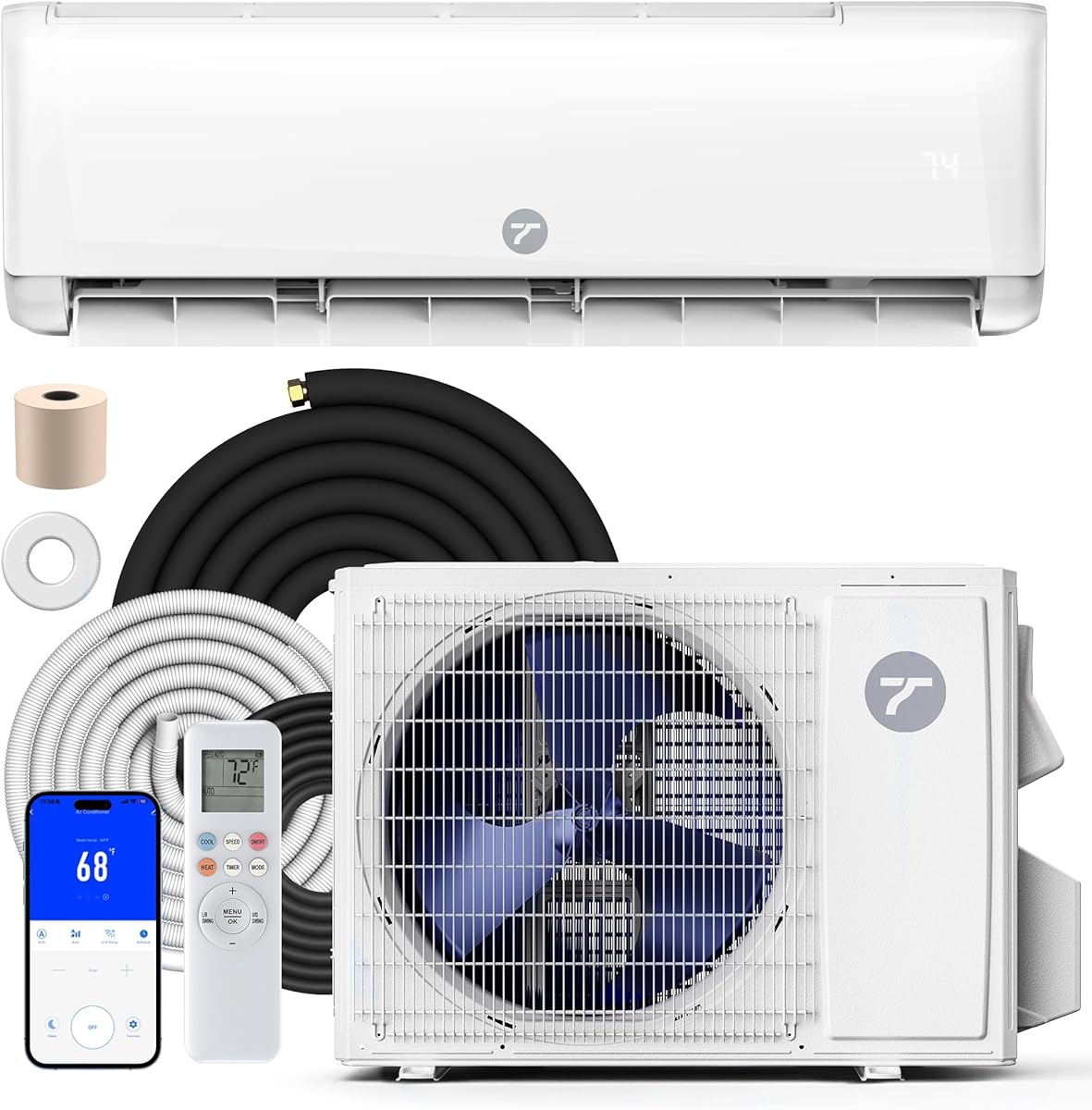


The ROVSUN 9000 BTU Mini Split is a practical choice for a tiny house or individual room where broad coverage would create unnecessary expense and complexity. Its stated 4.4 rating reflects a generally favorable owner experience, while the 20 SEER2 rating and inverter compressor make efficiency a central selling point. Coverage is listed for rooms as large as 400 square feet.
We may earn a commission when you buy through this link, at no additional cost to you.
This system combines cooling and heating in one wall-mounted unit, which is especially useful in small homes that cannot support separate seasonal equipment. The remote provides fan speed, sleep, 24-hour timer, eco, turbo, and mute controls, while four-way swing helps distribute air more evenly. A stated operating range of 28-42 dB and a lower setting for quiet operation are useful in a bedroom or home office.
The most important caveat is electrical and installation planning. Although the 115V specification can simplify service compared with many 230V mini splits, buyers must confirm that the tiny house has appropriate capacity and that the voltage matches. The product information also says extra professional installation is required, so the purchase should not be interpreted as a complete do-it-yourself HVAC project.
The ROVSUN is best for buyers who want a straightforward, efficient 9,000 BTU system without paying for extensive smart features. It suits studio homes, bedrooms, and well-insulated small spaces. Choose it when its room coverage, electrical requirements, and included installation components align with the building rather than selecting it solely by headline efficiency.
The 20 SEER2 rating and inverter operation are meaningful advantages in a home where conditioned space is limited. The system can moderate output rather than relying entirely on repeated full-power cycling, helping preserve temperature comfort without treating every square foot as though it needed maximum capacity.
Adding heat-pump heating eliminates the need for a separate heater in the covered area. The compact wall-mounted format and multi-directional swing make this one indoor unit a flexible solution for a tiny house where space for ductwork or multiple appliances is limited.
We may earn a commission when you buy through this link, at no additional cost to you.
The Tehanld 12000 BTU Mini Split combines a relatively strong cooling capacity with a 115V electrical requirement and coverage stated for rooms up to 750 square feet. Its 4.4 rating places it among the better-reviewed systems in this group. It is a flexible option for tiny houses that need more capacity than a 9,000 BTU model or expect occasional use in larger, open living areas.
We may earn a commission when you buy through this link, at no additional cost to you.
The inverter heat pump supports cooling, heating, auto, fan, and dry modes, with four fan speeds. A 24-hour timer, customizable sleep settings, and dedicated quiet, turbo, and eco modes provide a good range of everyday controls. The system uses R32 refrigerant, and the outdoor unit is described as operating down to -4°F, making it more relevant to cold climates than a basic cooling-only appliance.
Its principal tradeoff is efficiency. The 17 SEER2 rating is lower than the 20-23 SEER2 ratings offered by several competitors. That may not dominate the decision in a very small, well-insulated house, but it matters more for a lightly insulated dwelling, a sunroom, or a space requiring the system to operate for long periods.
Buyers should also account for installation logistics. The system ships as two separate packages, which may arrive at different times, and it requires installation by a licensed HVAC professional. The included nine-foot copper line set can be helpful, but its length must be checked against the planned indoor and outdoor unit locations. This Tehanld model best suits those prioritizing capacity, 115V operation, and cold-climate capability.
A 12,000 BTU output gives this system more cooling headroom than the compact 9,000 BTU choices. The stated coverage of 750 square feet can suit an open studio or tiny house when insulation, sunlight exposure, window area, and equipment loads are considered.
Operation down to -4°F makes the heat pump a more credible year-round option in cold conditions. Intelligent defrost is designed to preserve components and support reliable cold-weather operation rather than treating the heating function as a seasonal accessory.
We may earn a commission when you buy through this link, at no additional cost to you.
The DELLA Vario Series pairs 12,000 BTU cooling capacity with a 23 SEER2 rating, the highest efficiency figure among the ten systems listed. It carries a 4.4 rating and is designed for spaces up to 550 square feet. That combination makes it an efficient choice for a tiny house with moderate sun exposure and a reliable 208-230V supply.
We may earn a commission when you buy through this link, at no additional cost to you.
Its feature set is particularly comprehensive. Alexa compatibility, automatic defrost, self-diagnosis and cleaning, I Feel temperature sensing, dehumidification, a 24-hour timer, sleep mode, eco mode, multiple fan speeds, and compressor preheating support year-round convenience. The remote-location temperature sensor is useful in a compact room because it can align control with the actual occupied position rather than the indoor unit's placement.
A 28 dBA indoor operating level and a 60-90°F adjustment range make the unit suitable for sleeping and work areas. The trade-offs are installation demands. This is explicitly not a DIY mini split: line-set vacuuming is required, and changing the supplied line-set length requires adjusting the refrigerant charge. A 16.4-foot kit is included, but proper placement still matters.
The DELLA Vario is well suited to a buyer who wants more output than a 9,000 BTU unit without giving up strong efficiency. Its 23 SEER2 rating makes it attractive for long operating periods, while smart and automatic functions reduce daily adjustments. Confirm electrical capacity, wall locations, and professional installation availability before ordering.
A 23 SEER2 rating makes the Vario attractive for owners who expect steady year-round use. Efficient inverter modulation can help maintain a stable temperature in a small dwelling while reducing the energy penalty associated with frequent full-capacity cycling.
I Feel mode, sleep settings, automatic defrost, and multiple fan speeds provide a refined balance of comfort and automation. These features are especially helpful in a tiny house where one room serves as the bedroom, office, and primary living area.
We may earn a commission when you buy through this link, at no additional cost to you.
The Garvee Mini Split AC with Heat Pump is the strongest all-around choice in this roundup, earning a 4.5 rating alongside substantial feature coverage. Its 12,000 BTU output and stated capacity for rooms up to 750 square feet make it adaptable to many tiny houses, studios, and compact additions. The 18.5 SEER2 rating is a solid efficiency figure without placing it outside the mainstream range.
We may earn a commission when you buy through this link, at no additional cost to you.
Smart control is a major advantage. A built-in WiFi module, mobile app, and Alexa compatibility allow temperature, fan speed, mode, and timer adjustments from a phone or by voice. The standard remote remains available, while a custom sleep mode automatically adjusts room temperature and airflow. These features are useful in a small home where the occupant may want to prepare the space before returning or avoid nighttime noise.
Maintenance features also distinguish the Garvee. Automatic self-cleaning is intended to flush dust and residue from the indoor unit after operating cycles, while the reusable washable filter supports routine cleaning. The package includes the outdoor condenser, wall-mounted indoor handler, connection piping, drain hose, communication wire, remote, and manual.
The tradeoff is electrical and installation complexity. The system requires a 208-230V household supply and professional installation for safe, code-compliant operation. That makes it less convenient than a 115V system, but the smart controls, generous capacity, and balanced feature set justify the Garvee as the best overall option for a buyer whose tiny house has modern service and room for both equipment sections.
App, voice, and traditional remote control provide several ways to manage the same system. Scheduling is particularly valuable in a tiny house because a properly conditioned room can be ready before waking, working, or returning home without wasting energy on an empty interior.
The automatic cleaning cycle and washable filter reduce the maintenance burden compared with a unit that offers only manual filter care. These features do not eliminate periodic inspection, but they can help keep the indoor coil and airflow path cleaner between service visits.
We may earn a commission when you buy through this link, at no additional cost to you.
The Temprium 12000 BTU system combines a 22 SEER2 rating with a 115V supply, giving it one of the most attractive specifications in the roundup. Its 4.4 rating supports the appeal of a system designed for rooms up to 750 square feet. It is especially relevant to tiny-house owners who want substantial cooling and heating capacity without moving to a 230V circuit.
We may earn a commission when you buy through this link, at no additional cost to you.
The DC inverter compressor adjusts output as conditions change, and the listed performance includes 12,000 BTU cooling and 12,300 BTU heating. Heating operation extends down to 5°F, while cooling is stated to handle outdoor temperatures up to 122°F. A minimum noise level of 23 dB, sleep mode, seven operating modes, seven fan speeds, 4D swing, and I Feel mode create a strong comfort-control package.
WiFi app support, Alexa, and Google Assistant offer flexible remote and voice control. Maintenance features include a high-temperature self-cleaning function and a washable filter. The stated ETL and AHRI certifications provide useful reference points, though buyers should still verify documentation and installation requirements for their location.
One important caution is that the 750-square-foot maximum is a coverage guideline rather than a substitute for a professional load calculation. Tiny houses can have unusually high solar gain, poor insulation, or an open plan that increases cooling demand. The Temprium is an excellent candidate when 115V service, 12,000 BTU output, quiet operation, and strong efficiency are all priorities.
The combination of 22 SEER2 and 115V operation distinguishes this model from many high-capacity heat pumps. It gives owners an efficient option without requiring the same electrical infrastructure associated with 230V mini split installations.
At a stated minimum of 23 dB, the system is designed for spaces where equipment noise can interfere with sleep, focused work, or conversation. Sleep mode and the dimmed display further support nighttime use in a tiny house where the conditioned area may also be the primary living space.
We may earn a commission when you buy through this link, at no additional cost to you.
The Tehanld Mini Split AC/Heating System is a balanced 12,000 BTU model with a 4.5 rating, matching the highest numerical rating in the group. Designed for spaces up to 750 square feet, it offers enough nominal capacity for many tiny houses while using a 115V supply. Its 19 SEER2 efficiency places it comfortably in the middle of this roundup's range.
We may earn a commission when you buy through this link, at no additional cost to you.
Inverter technology allows the system to vary compressor output rather than simply cycling between full power and off. The R32 refrigerant has a lower stated global warming potential than many traditional refrigerants. Five operating modes, four fan speeds, a 24-hour timer, sleep mode, eco mode, and rapid cooling or heating provide enough control for daily use without requiring extensive smart connectivity.
The principal inconvenience is fulfillment and setup. The product ships in two separate packages, so accessories and equipment may not arrive together. The air filter also needs regular removal and cleaning. Professional installation is explicitly required, and outdoor placement must account for drainage, service clearance, and line-set routing.
This Tehanld model is most appropriate for a buyer who values a conventional, well-rounded heat pump without needing voice assistant integration. It stands out through its strong rating, 115V compatibility, and generous stated coverage. It is less distinctive than smart-equipped alternatives, but that simplicity can be an advantage in a small dwelling where reliable manual operation and straightforward seasonal control are the priorities.
The 19 SEER2 rating provides a useful middle ground between entry-level efficiency and the most efficient systems listed. Combined with 12,000 BTU of output, it can serve a compact dwelling without requiring the electrical and physical scale of a much larger heat pump.
Cool, heat, auto, fan, and dry modes cover the normal climate-control needs of a tiny house. The 24-hour timer and four fan speeds make it easier to create a repeatable schedule, while eco and sleep modes offer simple changes for efficiency and nighttime comfort.
We may earn a commission when you buy through this link, at no additional cost to you.
The DELLA Serena Series combines a compact 9,000 BTU size with 22 SEER2 efficiency and extensive smart-home integration. Its 4.2 rating is the lowest among the listed products, but the system offers a sophisticated feature set for tiny houses with up to 400 square feet of conditioned space. It is a strong premium option for buyers who prioritize controls, compactness, and cold-weather operation.
We may earn a commission when you buy through this link, at no additional cost to you.
The indoor unit is described as reaching 24 dBa in mute mode. WiFi, the DELLA app, Alexa, Google Home, and an included remote provide several control paths. A geolocation function can adjust operation based on occupancy patterns, while PureClean technology is intended to prevent dust buildup and support indoor-unit defrosting. Four-directional airflow, I Feel mode, a 24-hour timer, sleep, eco, turbo, and dry modes round out the controls.
A bottom heating element helps the outdoor condenser manage winter conditions, and stated heat-pump performance extends to 5°F. The 16.4-foot line set and 78.7-inch drain pipe are included, with the system preloaded with R32 refrigerant for up to 25 feet. The lower product rating should prompt buyers to examine current customer feedback carefully, particularly around installation and support experiences.
The Serena is best suited to a smaller tiny house, bedroom, studio, or office where compact equipment dimensions and smart control matter. It requires 230V service and professional installation, including line-set vacuuming and refrigerant adjustment if the line length changes. For a buyer willing to prioritize smart features, the 22 SEER2 efficiency makes this a compelling premium compact system.
The combination of app, voice assistant, geolocation, and remote control creates a flexible operating experience. In a tiny house, automatic adjustments can make a single multi-use space feel more consistently comfortable without requiring repeated manual changes.
A 9000 BTU output can be ideal for a small, well-insulated room, while the 22 SEER2 rating limits energy demand. Cold-weather capability down to 5°F and a heated outdoor condenser component strengthen its value for year-round use.
We may earn a commission when you buy through this link, at no additional cost to you.
The Temprium 24000 BTU Mini Split is the largest-capacity model in this guide, with a 4.4 rating and stated coverage up to 1,500 square feet. It provides 24,000 BTU of cooling and heating, making it more appropriate for a very small conventional home, an open studio, an accessory dwelling, or a compact building with unusually substantial cooling loads.
We may earn a commission when you buy through this link, at no additional cost to you.
The system uses an inverter compressor, 19 SEER2 efficiency, and R32 refrigerant. Operating features include WiFi app support, Alexa and Google Assistant compatibility, a backlit remote, seven operating modes, seven fan speeds, 4D swing, turbo, I Feel, and sleep mode. Its stated minimum noise level is 30 dB, which remains low for a system of this capacity.
Its biggest weakness for this audience is likely excess capacity. Installing a 24,000 BTU system in a 300- or 400-square-foot tiny house can create short-cycling concerns, unnecessary equipment cost, and a larger physical footprint than the space needs. A 230V supply is also required. The coverage figure alone should not drive the selection; professional sizing is essential.
This model makes the most sense for the upper end of the tiny-home market or for buildings with unusual heat gain. It also offers a path to heat a small open-plan residence with one indoor unit. For a typical compact dwelling, the smaller 9000, 9100, or 12000 BTU alternatives are more likely to deliver a better balance of capacity, control, and efficiency.
A 24,000 BTU system can support a larger open interior or cope with significant solar exposure. It may be useful for tiny houses that include a sunroom, workshop, or poorly insulated living area where a smaller heat pump would need to run continuously.
App, voice, and remote controls make it possible to schedule a powerful system around occupancy. Used with proper sizing, this can make temperature preparation convenient while avoiding the inefficiency of running maximum output continuously.
We may earn a commission when you buy through this link, at no additional cost to you.
This 12000 BTU inverter heat pump offers a practical combination of cooling capacity, 115V operation, and quiet indoor performance. Its 4.3 rating places it in the middle of the group. Although the product title lists coverage up to 750 square feet, the feature details also describe rapid cooling and heating for rooms up to 450 square feet, so buyers should request professional sizing rather than rely on the maximum figure.
We may earn a commission when you buy through this link, at no additional cost to you.
The inverter compressor adjusts speed instead of repeatedly cycling, and the manufacturer states that consumption can be reduced by as much as 35% relative to conventional units. The heat pump adds seasonal value, while auto defrost supports heating operation. Sleep and mute modes, a remote control, a washable filter, and a 135°F-plus self-cleaning function target everyday convenience and upkeep.
The lower SEER2 rating and ambiguous coverage information warrant attention. A 17 SEER2 figure is lower than the 19-23 ratings offered by many competitors, and installing 12,000 BTU in a space that only needs 9,000 may reduce operating economy. The 115V supply is still a meaningful advantage for homes without 230V capacity.
The unit is best for a buyer who prioritizes 115V service, moderate-to-high output, and low operating noise over sophisticated smart controls. It ships in two boxes that may arrive on different dates and includes a 9.8-foot copper line set. Professional installation is recommended, and the stated AHRI certification provides another point to verify with the seller.
The 115V specification can be the decisive advantage for tiny houses with limited service capacity. It allows buyers to consider a 12,000 BTU inverter system without immediately assuming that a dedicated 230V circuit is available.
A stated minimum of 26 dB and dedicated sleep and mute modes make the system appropriate for a bedroom or multipurpose room. The feature is especially valuable where the same indoor unit must remain unobtrusive during work and rest.
We may earn a commission when you buy through this link, at no additional cost to you.
The DELLA Umbra is a 9100 BTU inverter heat pump intended for rooms up to 400 square feet. Its 4.3 rating and 19 SEER2 efficiency place it between the highly efficient DELLA Serena and several less efficient 12,000 BTU systems. For a small studio, bedroom, or very compact tiny house, its slightly larger capacity than a 9000 BTU model may offer useful flexibility.
We may earn a commission when you buy through this link, at no additional cost to you.
Smart-home functions include WiFi and Alexa compatibility, while four-directional airflow, I Feel mode, a 24-hour timer, sleep mode, eco mode, multiple fan speeds, turbo, cooling, heating, and dry modes cover daily operation. A 25 dBA indoor operating level is among the quietest figures in the roundup and supports use in a bedroom or workspace.
The heat pump is described as operating down to 5°F, with an upgraded bottom heating element in the outdoor condenser. R32 refrigerant is used, and the package includes a 16.4-foot copper line with 1/4-inch and 3/8-inch dimensions plus a 6.56-foot drain pipe. The maximum fuse size is listed as 10A.
The Umbra is a good fit for buyers who want a compact, feature-rich system without moving to 12,000 BTU. Its primary constraints are the 230V supply and installation complexity. It is also worth checking local R32 service availability if the line set may be altered, as the product information specifically recommends confirming refrigerant availability before installation planning.
The 9100 BTU format is a practical middle ground for tiny spaces, offering slightly more nominal output than 9000 BTU models. Four-way airflow and I Feel mode help maintain even comfort around the occupied area of a compact room.
WiFi and Alexa support make scheduling straightforward, while the heated outdoor condenser and 5°F operating rating extend seasonal usefulness. These features give the Umbra a more year-round profile than a cooling-only mini split.
We may earn a commission when you buy through this link, at no additional cost to you.
The right mini split depends on floor area, insulation, sun exposure, electrical service, climate, and installation access. Capacity and efficiency should be evaluated together, with professional sizing taking priority over a maximum room-coverage number.
Mini split capacity is commonly expressed in BTU, and selecting by square footage alone can produce an undersized or oversized result. A 9,000 BTU model is commonly positioned for rooms up to 400 square feet, while many 12,000 BTU systems are listed for spaces up to 750 square feet. Those are maximum guidelines rather than promises, and variables such as ceiling height, window area, insulation, appliances, and direct sunlight can materially change demand.
Choose capacity using a professional load assessment and the unit's design conditions. A tiny house with excellent insulation may need less capacity than its floor area suggests, while a glass-heavy or west-facing structure may need more. Oversizing can encourage short cycling, while undersizing leaves the system unable to maintain its set temperature.
Several systems in this guide operate on 115V, while others require 208-230V. A 115V mini split can simplify electrical planning for a small detached structure, but the circuit still needs adequate capacity and appropriate protection. A 230V system may require a new dedicated circuit, larger breaker, additional wiring, and coordination with local electrical requirements.
Confirm voltage before ordering, and ask an electrician whether the existing service can support the chosen model. Do not assume that an ordinary household receptacle is sufficient. Equipment voltage, breaker size, wire gauge, grounding, and local code all need to align before installation.
SEER2 is a seasonal cooling-efficiency measure, and higher figures can reduce energy use compared with lower-rated products under comparable conditions. The guide includes systems from 17 to 23 SEER2, a meaningful range for owners who expect regular operation. Inverter compression is also important because the system can vary output rather than run only at full capacity.
Prioritize efficiency when the mini split is the primary cooling source, the house has substantial solar gain, or operating costs are a central concern. In a small, well-insulated, briefly occupied space, the savings may be less dramatic, so the full equipment and installation decision should still be evaluated as a whole.
A mini split heat pump can provide both cooling and heating, but low-temperature capability varies. Several products are specified down to 5°F, while DELLA Vario and Tehanld 12000 BTU state operation to -4°F. A lower rated minimum matters in regions with cold winters, particularly if the system is the only year-round climate-control equipment.
Review the compressor and outdoor-unit cold-weather features, defrost behavior, and installation environment. Heating output at low outdoor temperatures may be lower than nominal capacity. A qualified installer can assess whether the heat pump can carry the home through its coldest expected period or whether a supplemental heater would be prudent.
Tiny houses often concentrate living, working, and sleeping in a small area, making fan and compressor noise easier to notice. Stated minimum indoor noise figures range from 23 dB to 30 dB across this list. These are low-noise operating points rather than guaranteed sound levels at every mode, fan speed, or indoor-unit setting.
Prioritize units with dedicated sleep and mute modes, soft startup, and low-speed fan settings. Consider asking about the noise produced by the outdoor condenser as well, since it may sit near a bedroom, porch, or workspace. Placement and vibration control can matter as much as the published indoor-unit figure.
Remote controls are standard across the list, while WiFi, mobile apps, and voice assistants offer greater scheduling and monitoring. Smart functions are particularly useful in a tiny house when the system can be started from a phone before arrival or adjusted without leaving bed. They can also support occupancy-based routines, although automation should not replace sound sizing.
App and voice control are not essential for every owner. A simple remote with sleep, timer, and fan settings may be sufficient and can avoid dependence on network connectivity. If smart controls matter, confirm which voice platforms are supported and whether the functions require an account, separate hub, or particular phone configuration.
Most systems include some combination of copper line set, drain hose, communication wire, remote control, and mounting accessories. Included line sets vary from about 9.8 feet to 16.4 feet, and the available distance between indoor and outdoor units affects installation complexity. A long included kit does not automatically mean the geometry will work without alteration.
Have the installer verify line-set length, pipe dimensions, drain slope, electrical routing, and refrigerant requirements before the purchase is finalized. If the line set must be shortened or extended, the refrigerant charge may need adjustment. Some listings explicitly require vacuuming and professional installation.
Reusable washable filters are common, but the frequency of cleaning depends on dust, pets, cooking, and how often the system runs. Several models add high-temperature self-cleaning or automatic cleaning cycles. These functions can reduce residue, yet they do not make filters or coils permanently maintenance-free.
Plan regular filter cleaning and periodic professional inspection. Confirm local service availability, warranty terms, and the availability of replacement parts. For a remote tiny house, choosing a brand with accessible support and straightforward filter design can be more valuable than a small difference in operating-mode count.
Begin by learning the remote and setting a reasonable starting temperature. Use auto or eco mode when the room has ordinary occupancy, select dry mode for humid conditions, and choose sleep mode before bedtime. Avoid setting the thermostat drastically below the outdoor temperature, since the compressor cannot cool a room faster than the equipment and operating conditions allow.
Clean the reusable filter on a regular schedule and follow the manual's instructions for the self-cleaning cycle. Keep the indoor unit's airflow path unobstructed, maintain clearance around the outdoor condenser, and protect exposed lines or connections from physical damage. If the system develops unusual noise, odor, leakage, or error messages, contact qualified service personnel.
Allow professional installers to handle electrical connections, refrigerant work, line-set vacuuming, and any alteration of the supplied tubing. Before each heating season, have the system checked as required by the manufacturer and local service guidance. Keeping filters clean, using moderate setpoints, and scheduling operation around occupancy can preserve comfort while reducing energy use.
Most tiny houses fall into the 9,000 or 12,000 BTU categories, but square footage is only a starting point. A professional load assessment should consider insulation, ceiling height, window area, sun exposure, appliances, and the number of occupants. A slightly larger system may be justified in a hot, open, or poorly insulated building, while an oversized unit can cycle inefficiently in a small space.
Yes, a mini split heat pump can provide both cooling and heating through the same indoor unit. Several models in this guide are specified for operation down to 5°F, and two state performance to -4°F. Very cold locations should be evaluated for heating capacity at the lowest expected temperature, along with whether supplemental heat is appropriate.
Some do, including the ROVSUN, Tehanld 12000 BTU, Temprium 12000 BTU, and 12000 BTU inverter heat pump reviewed here. Other systems require 208-230V and may need a dedicated circuit. Confirm voltage, breaker requirements, and service capacity with a qualified electrician before purchasing or installing any model.
No. A larger model is beneficial when the home has high cooling loads, extensive glass, poor insulation, or a broad open plan. In a compact, efficient dwelling, excessive capacity may be less economical and difficult to condition evenly. Proper sizing is more important than selecting the highest BTU number available.
The indoor unit requires wall clearance for airflow, maintenance access, and control-signal reception. The outdoor unit also needs an approved installation space with ventilation and service access. Measure both locations and consult the installation guide before ordering, because equipment dimensions and local code requirements affect placement.
An included kit simplifies preparation but does not make installation automatic. Line-set length, electrical service, drain routing, wall mounting, refrigerant charging, and code requirements still need to be assessed. Several systems explicitly require a licensed HVAC professional, and changing line-set length can require a refrigerant adjustment.
They can be useful for scheduling, remote monitoring, and adjusting the system before occupying the home. They are less essential if the included remote, sleep mode, and timer meet your needs. When comparing smart features, verify supported platforms and consider whether reliable WiFi coverage and secure account setup are available in the building.
The interval depends on dust, pets, cooking, and operating frequency, but filters should be inspected routinely and cleaned whenever they become dirty. Many systems have reusable washable filters, and several also offer automatic or high-temperature self-cleaning functions. Always follow the specific cleaning and drying instructions in the product manual.
The ROVSUN 9000 BTU Mini Split stands out as the best value for a compact, 115V-ready home, while the Garvee 12000 BTU system is the most balanced overall selection because of its strong rating, app and voice controls, maintenance features, and 750-square-foot stated coverage. The DELLA Serena 9000 BTU system is the premium pick for buyers who prioritize smart integration, a 22 SEER2 rating, and ultra-quiet operation.
Beyond those headline choices, proper sizing and electrical preparation matter more than any single specification. A smaller 9,000 or 9,100 BTU model may be ideal for a well-insulated studio, while a 12,000 BTU system offers more capacity for an open tiny house or demanding solar exposure. Ask a qualified HVAC professional to evaluate the building before committing to equipment.
Product availability and prices change, so check current listings, installation costs, warranty terms, and local incentive programs before purchasing. Compare the complete system rather than focusing only on BTU or efficiency. A mini split for a tiny house is a long-term home investment, and the best model is the one that fits the space, service, climate, and daily routine.