
Aeros Loop Studio Gold Edition
4.2Editor score
Six stereo tracks per song
Touchscreen mixer and routing
Long-form internal recording capacity
USB, Wi-Fi, and Bluetooth connectivity
Our Multi Track Looper guide compares ten loopers for track count, audio quality, effects, recording capacity, connectivity, and live performance control.
A multi track looper gives performers the freedom to build arrangements in layers, connect separate instruments, and expand simple phrases into complete songs. The best model balances usable live controls, clear navigation, dependable recording, flexible effects, and enough connectivity to fit comfortably within an existing pedalboard or studio setup.
This guide compares ten looping pedals and loop stations using their stated track capacities, processing, effects, memory, inputs, outputs, control systems, and workflow features. It covers compact dual-track devices, larger tabletop and floor-based systems, and an advanced touchscreen looper designed for ambitious live and studio projects.
Each review identifies the capabilities that set one model apart, along with practical trade-offs to consider before buying. The list shows why the picks excel for different needs, while reminding shoppers that product availability, configurations, and retailer offers can change over time.
4.2Editor score

4.7Editor score
4.3Editor score
The comparison below highlights track count, processing, effects, storage, and connectivity across ten loopers suited to pedalboards, live rigs, and home studios.


The BOSS RC-505mkII stands out as the most complete all-around multi track looper in this guide, earning a 4.7 rating from the supplied product information. It combines five simultaneous stereo phrase tracks with 32-bit AD/DA conversion and 32-bit floating-point processing, giving performers a capable foundation for layered live arrangements, practice sessions, and compact studio work.
We may earn a commission when you buy through this link, at no additional cost to you.
Its two effects sections are especially important because the Input FX and Track FX chains operate independently. Each section provides four simultaneous effects, four quick-access banks, and a broad selection of effect types. The listed catalog includes 49 Input FX types and 53 Track FX types, spanning new Harmony and Electric FX options alongside the wider onboard collection. Dedicated faders for all five tracks support quick live balance changes, while customizable FX and Track buttons can be assigned to suit a particular performance style.
Connectivity is another strength. Two XLR microphone inputs with phantom power make the unit suitable for vocalists, acoustic performers, and multi-instrument rigs. Two stereo line input pairs and three stereo line output pairs allow instruments to be connected and routed more flexibly than on a conventional compact pedal. The 99-memory system stores five phrase tracks, effect settings, playback preferences, and control assignments, reducing the need to rebuild arrangements from scratch.
The trade-offs are its tabletop size and the depth of its control system. A performer who wants immediate simplicity may find the number of features distracting, while a musician who values five-track layering, routing, and deep effect control will find the extra learning curve worthwhile. The RC-505mkII is the recommendation for serious loopers who want a flexible centerpiece rather than a basic pedal.
Five dedicated phrase tracks give the performer more room to develop a loop into a layered arrangement. Independent volume faders make it possible to bring rhythms, bass lines, melodic fragments, and vocal textures into focus without leaving the performance workflow.
The microphone and line connections support broader rigs than a typical stompbox, while 99 memory locations preserve arrangements and their settings. That combination makes the unit practical for rehearsals, recurring live sets, and producers who want organized loop recall.
We may earn a commission when you buy through this link, at no additional cost to you.
The BOSS RC-600 is built for musicians who want maximum layering and direct foot control without navigating a small tabletop display. Its six simultaneous stereo phrase tracks exceed the RC-505mkII's five-track capacity, while 32-bit AD/DA conversion and 32-bit floating-point processing support modern recording quality. The supplied 4.4 rating reflects a strong feature set and broad appeal for guitarists, singer-songwriters, and multi-instrumentalists.
We may earn a commission when you buy through this link, at no additional cost to you.
Nine freely assignable footswitches are the centerpiece of the design. Rather than assigning a fixed command to every switch, performers can configure the floor unit around their own sequence. Three pedal modes add further flexibility, allowing a musician to decide how the hardware behaves within a set. This is valuable when recording, overdubbing, switching tracks, and controlling effects must all happen during a live performance.
The effects architecture follows the established BOSS approach with separate Input FX and Track FX sections. The unit provides 49 Input FX types and 53 Track FX types, with four effects available simultaneously in each section. This allows incoming audio to be shaped before it reaches the loops, while individual tracks can carry their own processing. The result is more tonal control than a simple looper can offer.
The main compromise is physical size. As a floor-based unit, it requires a larger pedalboard footprint and may be unnecessary for players who only need a few layers. Even so, the RC-600 offers the most generous simultaneous track count in the group and an unusually direct performance interface. It is a compelling choice for the serious looper whose priority is live control and complex arrangements.
Six stereo tracks let performers maintain a larger number of parts at once, from a core groove to supporting instruments and final vocal layers. This capacity is useful for songwriters who want to discover arrangements in real time rather than reconstructing them later in a DAW.
Nine freely assignable footswitches allow the RC-600 to adapt to a performer’s preferred command order. The result is faster access to essential actions during rehearsal or a live set, especially when hands remain occupied with the instrument.
We may earn a commission when you buy through this link, at no additional cost to you.
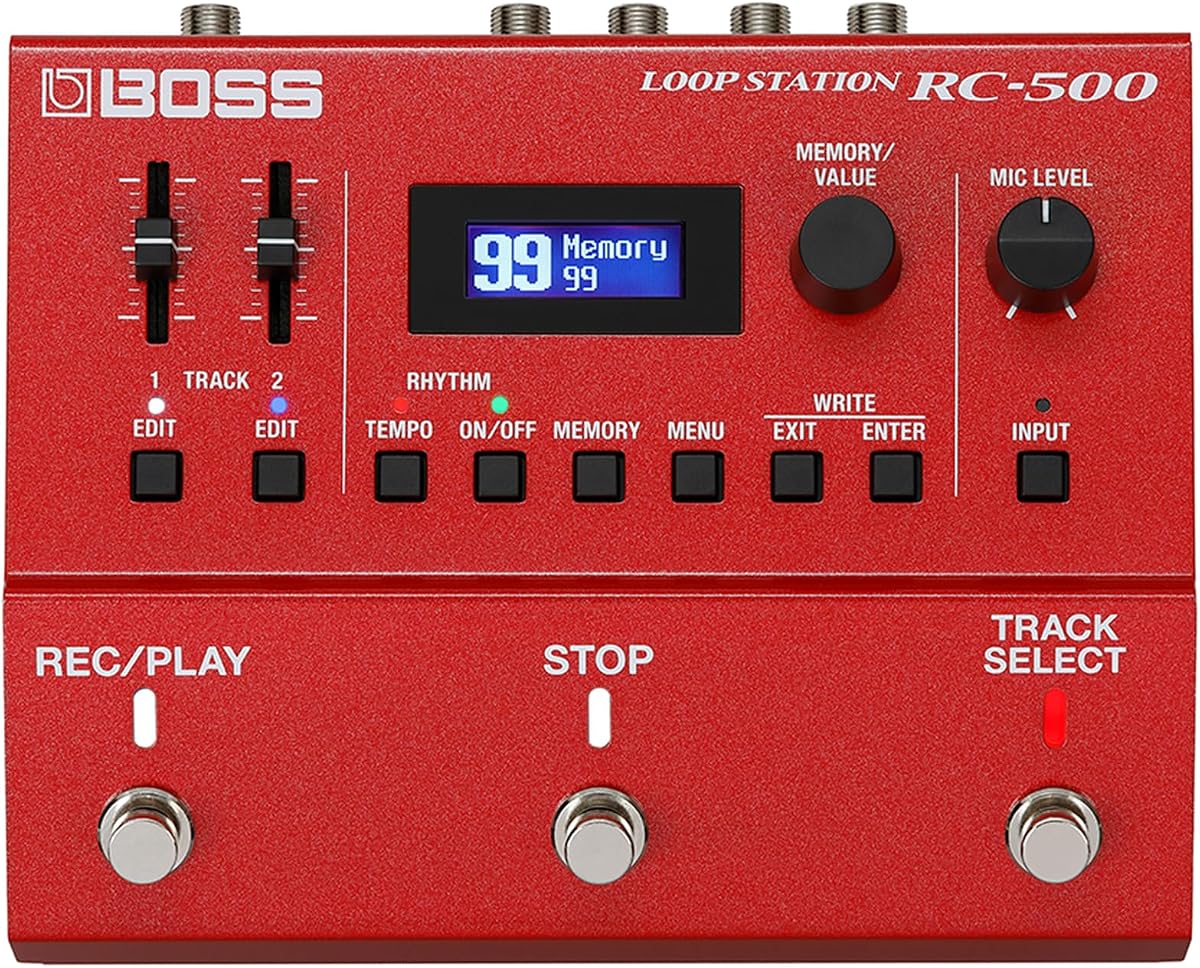
The BOSS RC-500 offers a balanced mix of recording capacity, effects, rhythm support, and practical connectivity. Its dual-track configuration is more capable than a basic single-loop pedal while remaining simpler than the five- and six-track systems higher in the list. The supplied 4.3 rating reflects a versatile device that can function as a practice partner, songwriting tool, or live looping centerpiece.
We may earn a commission when you buy through this link, at no additional cost to you.
Recording capacity is a major attraction. The pedal provides up to 13 hours of stereo recording in a single-track configuration, giving users room for long riffs, practice passages, and developing song ideas. A multi-color LCD provides clear visual feedback for loop status and parameter editing, while reverse and Loop FX options add character through repeat, scatter, shift, and vinyl flick effects.
Rhythm support is unusually thorough for a pedal. The onboard library contains 16 drum kits and 57 preset rhythms with A/B variations, which can support practice, composition, and live performance. Full MIDI I/O is provided through mini TRS connections, although a BMIDI-5-35 adaptor is needed separately. USB connectivity also allows WAV loops to be backed up and loaded for integration with a digital audio workflow.
The main limitation is obvious but manageable: only two tracks can be layered at once. Musicians who need a large, evolving ensemble arrangement should move up to a larger system. For guitarists and singer-songwriters who want a dependable stereo looper with generous storage, rhythms, and file transfer, the RC-500 offers especially strong value.
The combination of 16 drum kits and 57 rhythms with A/B variations gives players an immediate rhythmic foundation. It can help a songwriter test arrangements, guide a practice session, or expose timing problems before committing a phrase to memory.
USB import and export allow recorded WAV loops to move between the pedal and a computer-based workflow. That makes captured ideas easier to organize, refine, and incorporate into larger projects.
We may earn a commission when you buy through this link, at no additional cost to you.
This Boss RC-505 Mk2 listing offers the same fundamental five-track tabletop concept as the more extensively described RC-505mkII entry, with a 4.5 rating. The stated highlights—five stereo tracks, two XLR microphone inputs, phantom power, two stereo line input pairs, a rhythm generator, and dedicated looping controls—make it attractive to performers who want broad routing in a tabletop format.
We may earn a commission when you buy through this link, at no additional cost to you.
Five simultaneous tracks provide enough room for a structured loop without approaching the six-track maximum of the floor-based RC-600. The dedicated controls can be used to build a performance around separate phrase layers, while the rhythm generator offers a timing source for practicing, composing, and layering loops. Multiple input types are especially useful for a singer who wants to record a vocal over an instrument, or for a multi-instrumentalist connecting different sources.
As a tabletop system, the RC-505 Mk2 is better suited to a stable stage, studio desk, or shelf than to a crowded pedalboard. Its external controls can be easier to read and adjust than the tiny buttons found on many compact loopers. The included product information is concise, however, so buyers should compare the complete current specification with other RC-505 listings and confirm the exact bundle or configuration.
This is a sensible choice for a musician who prioritizes five tracks, flexible input types, and quick physical controls. It may be especially appealing to performers who want a rhythm source and looping workflow in one unit. The compact number of highlights in the listing does not diminish the model’s core value, but it makes careful product-page verification important.
Five tracks provide enough depth for arrangements built from rhythm, bass, melody, texture, and vocals. The tabletop layout also makes the unit more approachable than a densely packed pedal once the performer becomes familiar with its controls.
Two XLR inputs with phantom power and two stereo line input pairs support a wider range of sources. That flexibility is useful for live performers who alternate between an instrument and voice without requiring separate recording hardware.
We may earn a commission when you buy through this link, at no additional cost to you.
The Aeros Loop Studio Gold Edition is the most feature-forward looper here, combining six stereo tracks per song with a touchscreen mixer and extensive connectivity. Its 4.2 rating reflects a sophisticated device aimed at guitarists, vocalists, multi-instrumentalists, and producers who want to do much more than capture a single repeating phrase.
We may earn a commission when you buy through this link, at no additional cost to you.
Each song can contain six parts and six stereo tracks with unlimited overdubs. Recording capacity reaches up to 10 hours per song, while 48 or more hours of loops can be stored using a 32GB SD card, which is not included. Internal storage and SD support make the Gold Edition useful for maintaining multiple arrangements, while 32-bit floating-point audio provides a modern processing foundation.
Creative tools include Reverse, Fade In/Out, and Loop Decay, allowing recorded material to evolve rather than repeat identically. The touchscreen mixer is especially important for a six-track system because it provides a centralized way to inspect and balance layers. MIDI controller support is present, and USB, Wi-Fi, and Bluetooth connectivity broaden options for file transfer, control, and wireless audio workflows.
Its complexity is the main drawback. The feature set and touchscreen-based navigation may require more study than a conventional pedal with dedicated buttons, and a performer who only needs basic looping may not use many of the advanced functions. The Aeros is the premium recommendation for anyone who values track depth, large-scale storage, and connected studio flexibility enough to learn a more capable interface.
Ten hours of recording per song and more than 48 hours of possible SD-based loop storage provide substantial room for extended arrangements. The system is designed for performers who want to preserve complete projects rather than only a handful of live phrases.
USB, Wi-Fi, Bluetooth, and MIDI controller support create multiple paths for moving material and controlling playback. These features are particularly valuable when the Aeros is used as the center of a home studio rather than as an isolated pedal.
We may earn a commission when you buy through this link, at no additional cost to you.
The original Singular Sound Aeros combines six song parts with six tracks per song and unlimited overdubs, creating a substantial looping canvas for live performance and composition. Its 4.2 rating aligns with a capable device whose most appealing quality is its clear visual organization: LCD screens and color-coded waveforms help performers understand what is playing and what is waiting to be recorded.
We may earn a commission when you buy through this link, at no additional cost to you.
The Mixer View provides master and individual track control, which is essential when several layers are active. A performer can build a six-part arrangement while retaining the ability to adjust the balance during playback. Up to 10 hours of recording per song makes it possible to develop a long-form piece, revisit an idea later, or capture extended practice passages without relying on an external recorder.
Multiple inputs and outputs with routing options allow up to three instruments to be connected. The unit is therefore suitable for guitarists expanding into bass or keys, as well as loopers who want to add vocals. Loops can be saved to internal storage or an SD card, which is not included, and exported for later use in a DAW. A 2-year manufacturer warranty and included 9V power supply support its role as durable stage equipment.
Compared with the Gold Edition, this model focuses more on the core six-track workflow and less on the newest wireless and touchscreen features. Its storage capacity is also less expansive. Still, the intuitive waveform display, mixer, routing, and export options make the original Aeros attractive for performers who prioritize quick visual feedback and dependable multi-instrument control.
Color-coded waveforms make it easier to distinguish active, recorded, and upcoming layers. In a six-track system, that visual feedback can save time and reduce confusion during rehearsal or a live set.
Support for up to three instruments broadens the role of the Aeros beyond guitar looping. Individual track mixing and export help performers build arrangements that can later be refined in a DAW.
We may earn a commission when you buy through this link, at no additional cost to you.
The MOOER GL200 is not a conventional multi-track looper because it focuses on a single looping location with a large library of independent slots. Its 4.0 rating reflects a broad collection of rhythm, recording, connectivity, and automation features inside a compact pedal. It is most compelling for guitarists and home practice users who want a looper and drum machine in one device.
We may earn a commission when you buy through this link, at no additional cost to you.
DrumMatch AI is the most distinctive feature. It analyzes a performed phrase and automatically matches an appropriate groove and tempo, reducing the need to configure a backing pattern before every recording. There are 220 rhythms across 11 styles, while 100 storage slots and up to 800 total minutes of stereo recording provide room for complete arrangements or extended practice material. Each slot can retain its own drum groove, BPM, and time signature.
The GL200 also supports Auto Record, Count-In, and End Sync. Auto Record starts capturing when the player begins, Count-In provides a tempo-aware pre-roll, and End Sync aligns the loop ending to a bar or half-bar resolution. A 1.28-inch circular touchscreen, dedicated knobs, and three footswitches cover record, play, overdub, undo, redo, and slot switching. Time Stretch changes playback speed without changing pitch, while phrase jumping allows movement between stored locations.
Its primary limitation is track layering: despite the generous storage, it is not designed to play several independently mixed phrase tracks at once. The compact display may also be less informative than a larger color screen. Nevertheless, for a musician who values drums, automation, MIDI, Bluetooth audio, and flexible input options more than traditional multi-track mixing, the GL200 is unusually capable.
Automatic groove and tempo matching reduces setup time by responding to the phrase being played. The large rhythm library further supports quick changes across styles while preserving a useful practice partner.
Auto Record, Count-In, and End Sync work together to reduce timing gaps and keep endings aligned with the groove. These tools are helpful for players who want dependable practice support with less manual intervention.
We may earn a commission when you buy through this link, at no additional cost to you.
The TC Electronic DITTO X4 is a straightforward dual-track pedal for players who want to move beyond one-loop operation without navigating a large loop station. Its 4.1 rating reflects a focused design centered on two tracks, live loop effects, MIDI synchronization, and an analog dry signal. It is a natural fit for a compact pedalboard and for guitarists building simple recurring arrangements.
We may earn a commission when you buy through this link, at no additional cost to you.
Two loop tracks allow a performer to layer evolving material into fuller compositions. Seven loop effects provide ways to vary playback and develop recorded phrases, while Loop Decay offers another layer of dynamic control. These features make the X4 useful for ambient textures, rhythmic ostinatos, and short live arrangements that do not require the deep track mixing of larger devices.
MIDI sync is the feature most likely to extend its usefulness. Connecting the looper to a compatible tempo source can help keep live loops aligned with other parts of a setup. True bypass and analog dry-through also appeal to guitarists who want the pedal to stay out of the signal path when it is not actively shaping the sound.
The DITTO X4 does not offer the memory, file management, effects processing, input routing, or recording capacity found in the BOSS and Aeros systems. That makes it less appropriate for a player planning large arrangements or studio exports. Its advantage is focus: a simple, compact design that performs two-track looping well and leaves room on the pedalboard for other effects.
The second track turns a simple pedal into a basic arrangement tool. Players can maintain one part while adding another, creating more movement without navigating a complex multi-track interface.
True bypass and analog dry-through help the X4 coexist with other stompboxes. It can sit in a chain without requiring a complicated switching setup when no looping or loop effect is active.
We may earn a commission when you buy through this link, at no additional cost to you.
This BOSS RC-500 listing highlights a performance-friendly dual-track configuration with a 4.5 rating. The two-track RC-500 offers the essential BOSS looping experience in a pedal format, combining up to 13 hours of stereo recording with onboard rhythms, a multicolor backlit LCD, and USB import and export. It is a familiar option for guitarists who want more than a basic looper without the footprint of a tabletop or floor unit.
We may earn a commission when you buy through this link, at no additional cost to you.
The generous recording time makes the pedal useful for long practice sessions and developing song ideas. A multicolor backlit display gives clearer status feedback than a plain monochrome screen, helping performers understand recording and playback states. Onboard rhythm tracks provide a timing reference for practicing, writing, and layering, so the pedal can function as both looper and practice partner.
USB import and export provide a direct path for moving WAV material into a computer-based workflow. This is valuable for musicians who want to preserve good takes, organize ideas, and continue editing outside the pedal. XLR and quarter-inch inputs further broaden the source options, allowing a performer to connect instruments or microphones according to the equipment at hand.
Like the other RC-500 configuration, the principal limitation is its two-track ceiling. It cannot create the same number of independently mixed layers as the RC-505mkII, RC-600, or Aeros systems. For musicians who need a compact pedal, substantial recording capacity, rhythms, and file transfer, however, this RC-500 listing offers an appealing balance of features.
The multicolor backlit LCD communicates loop status more clearly in rehearsal or performance conditions. Clear feedback reduces the need to stop and study the controls each time a recording state changes.
With up to 13 hours of stereo recording, players can capture complete sections instead of short phrases. USB file transfer then gives those recordings a path into a broader creative workflow.
We may earn a commission when you buy through this link, at no additional cost to you.
The BOSS RC-300 remains a capable three-track looper with a 4.5 rating, offering dedicated footswitches and controls for every stereo phrase track. Its direct, performance-oriented layout gives players access to three layers without navigating a touchscreen, and the dedicated per-track faders simplify live balancing between loops.
We may earn a commission when you buy through this link, at no additional cost to you.
Three tracks are enough for a basic arrangement built around a core phrase, a supporting part, and a final accent or vocal layer. The supplied information notes up to three hours of internal recording and 99 onboard memory locations, so a musician can save many arrangements and recall them for regular performances. Dedicated controls for each track also reduce the time spent searching through menu structures.
Expression pedal support adds another layer of hands-free control. A performer can assign real-time effects control to a pedal and use the unit’s footswitches for recording and playback, creating a more fluid stage workflow. The RC-300’s controls are direct by design, making it approachable for players who want track-based looping without the complexity of newer touchscreen systems.
Compared with current models, its three hours of recording is modest, and its specifications do not include the extensive effects, file transfer, modern connectivity, or high-resolution processing found elsewhere in this guide. Nevertheless, the RC-300 delivers the essential benefit of a dedicated multi-track looper: several independently controlled stereo parts with straightforward performance access.
A footswitch and dedicated fader for each phrase track make live selection and balancing straightforward. This direct layout is helpful during rehearsals and reduces reliance on deeper menu navigation.
Ninety-nine onboard memory locations provide room to store arrangements and retrieve them without rebuilding the setup. That is especially helpful for musicians who use the same set of loops across multiple performances.
We may earn a commission when you buy through this link, at no additional cost to you.
The right multi track looper depends on how many layers you need, how you will control them during a performance, and whether the pedal must also handle microphones, backing tracks, rhythms, file transfer, or studio-level routing.
Track count is the clearest way to separate compact loopers from full arrangement systems. The DITTO X4 and RC-500 provide two tracks, the RC-300 offers three, the RC-505 family provides five, and the RC-600 and Aeros models support six. More tracks allow a musician to maintain a rhythm, bass part, melody, vocal, and one or more textures at once, but they also require more control and mixing attention.
Recording time affects how long you can capture before saving or exporting, while memory locations determine how many songs can remain on the unit. The RC-500 offers up to 13 hours of stereo recording and 99 phrase memories, while the RC-505mkII also provides 99 memories containing multiple tracks and settings. The Aeros Gold adds long song-level recording and SD-based expansion. The RC-300 supports up to three hours but still offers 99 onboard memories.
A loop station should be easy to operate while playing an instrument. Footswitch-heavy models such as the RC-600 and RC-300 favor direct access, while the Aeros Gold uses a touchscreen for centralized navigation. Smaller screens can save space, but they may demand more attention than dedicated buttons. Consider whether you prefer assigning physical commands, touching a display, changing values with knobs, or relying on MIDI and external controllers.
The RC-505mkII, RC-600, and RC-500 use 32-bit conversion and floating-point processing, while the Aeros Gold also lists 32-bit floating-point audio. Larger BOSS systems provide separate Input FX and Track FX sections, with four effects simultaneously available in each. The Aeros adds Reverse, Fade In/Out, and Loop Decay, whereas the DITTO X4 concentrates on seven loop-specific effects. Decide whether separate input and track processing is essential or whether simple loop variations are enough.
A guitarist with a single instrument may need only basic pedal-level connections, while a vocalist or multi-instrumentalist may require XLR inputs, phantom power, several line inputs, and flexible routing. The RC-505mkII includes two XLR microphone inputs, two stereo line input pairs, and three stereo line output pairs. The Aeros models support multiple instruments, while the DITTO X4 and RC-500 focus on a simpler pedalboard connection.
Onboard rhythms can make a looper useful for practice even before layering begins. The RC-500 provides 16 drum kits and 57 rhythms with A/B variations, while the GL200 offers 220 patterns across 11 styles and automatic phrase matching. MIDI synchronization appears on the RC-500, RC-505 Mk2, DITTO X4, and GL200. Tempo support is valuable when the looper must remain aligned with a drum machine, backing track, or another MIDI-capable device.
USB import and export can turn a live looper into a source of reusable studio material. The RC-500 can back up and load WAV loops, and the Aeros models support internal storage, SD cards, and export to a DAW. The Aeros Gold also includes USB, Wi-Fi, and Bluetooth. These features are most useful for songwriters who want to capture ideas quickly and continue refining them in a computer-based production environment.
Physical size affects every practical detail, from pedalboard space to stage visibility. The RC-600 is floor-based, the RC-505 and Aeros systems are tabletop devices, and the RC-500, RC-300, DITTO X4, and GL200 are more pedal-oriented. A tabletop unit may offer easier editing and a larger display, while a stompbox preserves pedalboard space. Choose based on where the looper will live and how much room remains for a power supply, cables, and other controls.
Start by learning the basic recording state changes before attempting a complex arrangement. Connect the input, choose or set a tempo, place the looper in record mode, and play a short phrase. Stop the recording, listen to the playback, and practice overdubbing before combining several tracks. This establishes muscle memory and helps prevent accidental overwrites or recordings made at the wrong tempo.
Build a repeatable routing plan. Decide which instrument feeds each input, which track receives each source, and where the final output should travel. Save a basic set of track levels, effects, and assignments after creating a useful sound. On models with phrase memories or numbered songs, use separate locations for complete arrangements and keep experimental loops away from trusted material.
Protect the device by following the power and storage guidance supplied with it, avoiding moisture and extreme heat, and securing cables so they cannot pull against the enclosure. Back up important recordings to a computer or card when the model supports file transfer. Clean the surface with a dry or lightly damp cloth, keep liquids away from controls and connectors, and periodically verify that saved loops still play as expected.
Two tracks are usually enough for simple layers, while three supports a more recognizable arrangement. Five or six tracks suit performers who routinely build arrangements with separate rhythm, bass, melodic, vocal, and textural parts. The correct number depends on the complexity of your music and how much live mixing you want to control.
It depends on the model and its input configuration. The BOSS RC-505mkII and RC-505 Mk2 include two XLR microphone inputs with phantom power plus stereo line inputs, while the Aeros systems support multiple instrument connections. Check the input count, connector type, and routing before assuming a pedal can capture every source simultaneously.
A tabletop model generally offers more controls, a larger interface, and broader routing, making it better for detailed arrangements and studio use. A pedal is more convenient on a crowded pedalboard and may be sufficient for two-track layering. The best choice depends on the number of tracks, available space, and the complexity of the performances you plan.
Many support a suitable way to synchronize with a tempo source, including MIDI, onboard rhythms, or audio connections. The DITTO X4 offers MIDI sync, the RC-500 includes rhythms and MIDI, and the GL200 supports MIDI clock and start/stop as well as Bluetooth audio. Verify the specific connection method and required equipment before buying.
Look for the highest practical conversion and processing specification available in your budget, especially if the output will be recorded or used in a live PA. The BOSS RC-505mkII, RC-600, and RC-500 feature 32-bit AD/DA conversion with 32-bit floating-point processing, while the Aeros Gold lists 32-bit floating-point audio.
Some models are designed for that workflow. The RC-500 can back up and load WAV loops over USB, while the Aeros models can save to internal storage or an SD card and export material for use in a DAW. The SD card used with the Aeros is not included, so it must be supplied separately if needed.
They are especially useful for practice, song development, and performances where a rhythmic foundation is needed. The RC-500 includes 16 drum kits and 57 preset rhythms, and the GL200 goes further with 220 patterns and automatic phrase matching. A musician focused on overdubbing an existing backing track may prioritize MIDI sync instead.
Record and save a complete demonstration of every command you intend to use, then label the physical controls. Practice changing tracks, starting an overdub, undoing a take, and ending a loop in the exact order you expect under pressure. Keep a separate backup of essential loops and verify output levels with the rest of the live signal chain.
The BOSS RC-505mkII is the strongest overall choice because it balances five stereo tracks, separate input and track effects, extensive routing, and deep memory recall in a tabletop format. The Aeros Loop Studio Gold Edition is the premium option for performers who want a touchscreen mixer, six tracks, extensive storage, and modern connectivity, while the BOSS RC-500 provides the most compelling value among the well-equipped dual-track models.
Your priorities should guide the final decision. Choose fewer tracks for a simple pedalboard workflow, more tracks for complex arrangements, and broad routing when recording several instruments or voices. Evaluate connectivity, MIDI synchronization, file transfer, and onboard rhythms alongside track count, because the most technically impressive looper is not necessarily the easiest to use in your particular setup.
Before purchasing, verify the current specification, bundle contents, connector requirements, and available accessories on the product listing. Retail availability and product offers can change, so compare the latest information rather than relying only on an earlier saved page. A little setup planning will make the chosen multi track looper far more useful at rehearsal, onstage, or in the studio.